www.newstower.ng

‘MY WIFE LEFT ME WHEN I NEEDED HER MOST – JUSTICE GALUMJE ; WE STAND IN SOLIDARITY WITH YOU, PSC CHAIR

By Ebinum Samuel


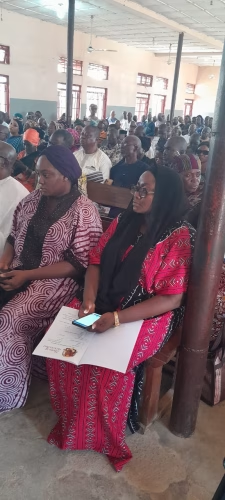
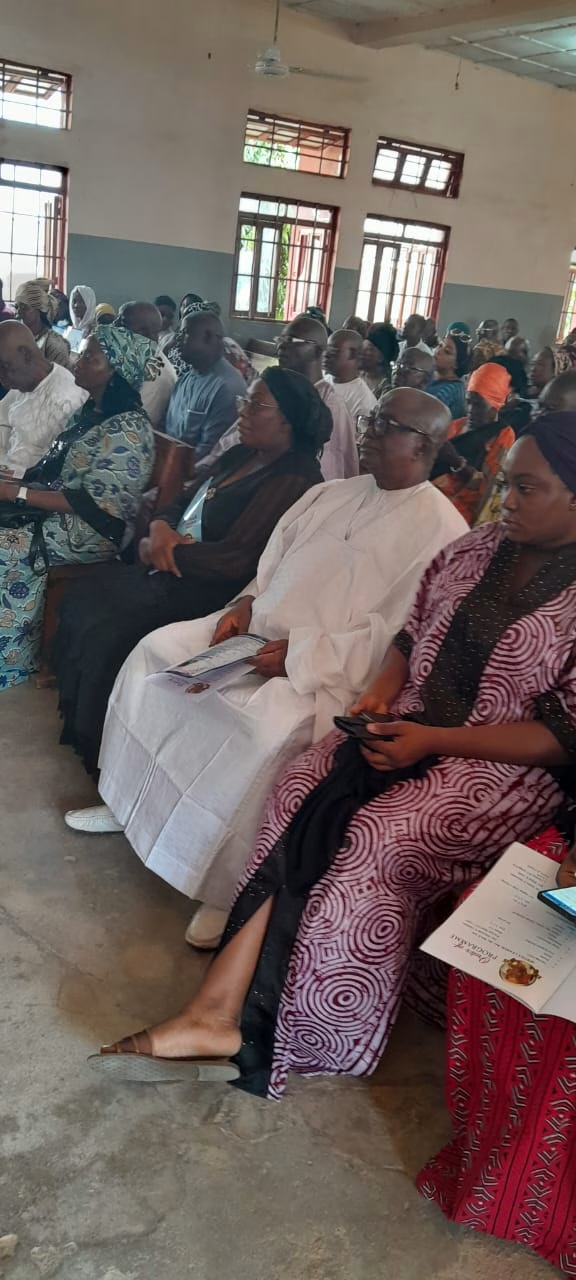
As the burial rites of Mrs Zeporah Galmuje, wife of Justice Paul Adamu Galumje, retired Justice of the Supreme Court and Honourable Commissioner representing the Judiciary in the Police Service Commission winds down, the Chief Mourner yesterday at a wake keep in Jalingo bemoaned the fate that has befallen him.

Justice Galumje who had at a Service of Songs programme in Abuja for the late wife disclosed that he and his wife had voluntarily agreed when they got married that only death can separate them, which he said they fulfilled with the passing on of the wife on the 4th of June this year.

But yesterday while speaking at the Wake Keep held at the Christian Reformed Church- Nigeria in Jalingo, Taraba state, the retired Justice of the Supreme Court regretted that “she left me at the age and time I needed her most. At my age, I needed her but she is no longer with me but I will remain alone till it is time for God to call me home”. “My wife created peace in my life and in my house but she has gone and will never come back to me. I am however strong and it is coming from the Almighty God”.

In a tribute at the Wake Keep, the Chairman of the Police Service Commission, DIG Hashimu Argungu rtd mni, said the Commission stands in solidarity with Justice Galumje during this time of grief.

DIG Argungu who was represented by Mr. Ikechukwu Ani , Head, Press and Public Relations of the Commission said the late wife of Justice Galumje “was a woman of dignity, compassion with an unwavering support not only to her family but also as a source of encouragement and stability to her husband throughout his distinguished career in the Judiciary “.

In her quiet way, she contributed immensely to the peace and harmony that made it possible for Justice Galume to serve the nation with such commitment and honour. She was a great woman whose sacrifices although silent, was deeply significant”

According to the Commission’s spokesman, Ikechukwu Ani,the PSC Chairman said, “we are gathered here to honour the memory and celebrate the life of a woman who meant so much to her family, her community, and everyone who had the privilege to know her. We mourn with you in this moment of profound loss, we know that no words can fully express the pain of losing a life partner, a confidant, and a pillar of strenght.

” At this time, we pray for comfort and strength for the family – Justice Galumje, the children, grand children, and all loved ones. May God in his infinite mercy grant her eternal rest and reward her with paradise “

The remains of late Mrs Zeporah Galmuje will be committed to mother earth, tomorrow, Saturday, June 21st 2025 at her husband’s village, Didan Taraba.

TINUBU’S TRIP TO TROUBLED BENUE AND TOR TIV’S “TORCHLIGHT”


By Tunde Olusunle


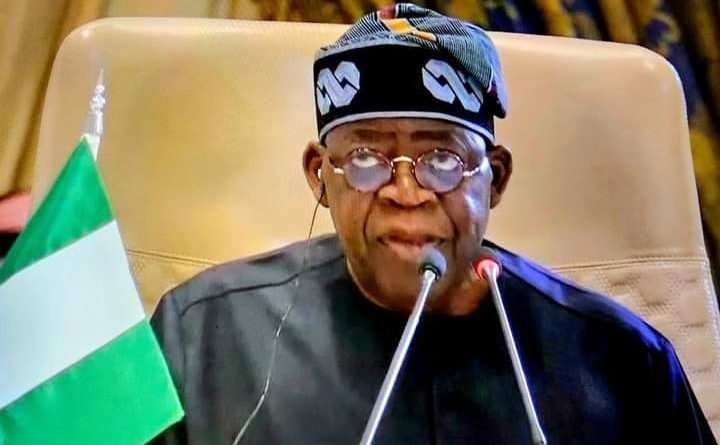
An essay of mine, Obasanjo, Atiku and Tinubu at a Time Like this published on June 1, 2025, canvassed that President Bola Tinubu took time off his Eid-el-Kabir break in Lagos, to visit troubled spots across the country. It sought to pitch the response time of former Nigerian leaders, notably President Olusegun Obasanjo and Vice President Atiku Abubakar, during periods of concerning tragedies, against that of President Bola Tinubu, following recent grievous national calamities. Much as the Air India plane crash of Sunday June 15, 2025, which claimed the lives of 241 passengers occurred two days after the most recent bloodletting in Benue State, the reaction time of the Indian Prime Minister to the tragedy, Narendra Modi, was swift and noteworthy. He was physically on the site of the devastation at Ahmedabad, within hours, which also claimed 29 lives on the ground, which brought the casualty figures to 270. The 74 year-old Indian leader proceeded thereafter to the hospital bed of Vishwashkumar Ramesh, the sole survivor of the tragedy.

President Tinubu signed off from Abuja on Tuesday May 27, 2025 for a two-week period, to attend official functions in Nigeria’s former capital and to observe the religious holiday in his home state, Lagos. This was at a time parts of the country, notably Benue, Plateau, Borno, Kwara were in the throes of various degrees of destabilisation and discombobulation, fuelled by a worrying resurgence of banditry, insurgency and terrorism. The President could always come back to receive his guests during the period and fete them to barbecued-hospitality in Lagos, after assuaging his constituents in these troubled spots. His personal appearance would reassure residents in each troubled entity and flashpoint. He would, during the envisioned visits, renew his charge to the intelligence, security and military apparachik containing these troubled areas, in his capacity as Commander-in-Chief, to be more decisive and ruthless in apprehending and punishing perpetrators.

Demon-crazed, vile and vicious assailants in overwhelming numbers, invaded Daudu and Yelewata communities in Guma local government area in Benue State, the night of Friday June 13, 2025, through the early hours of Saturday June 14, 2025. Homes of locals were targeted, doused with petrol and set ablaze. An estimated 200 people were so incinerated by the rampaging outlaws. Many Nigerians anticipated prompt and decisive action from the President. Their disappointments were writ large on their foreheads, however, seeing on the front covers of some respected national dailies the very next morning photographs featuring a smiling Tinubu receiving in audience some former state governors. They were chaperoned by Nyesom Wike, Minister of the Federal Capital Territory Administration, (FCTA), the self-appointed chief campaigner for Tinubu’s second term. Spontaneous national outrage compelled the President to announce at a public function in Abuja, Monday June 16, 2025, that he would visit Benue on Wednesday June 18, 2025.

Hyacinth Alia, the Catholic Priest who is Governor of Benue State, was evidently overwhelmed by the imminent visit of the President. The pervading air of weeping and wailing which characterised the recent onslaught on Alia’s people, required that they be adorned with sackcloth as they continued to mourn their kinsmen. An official correspondence from one of Alia’s aides, however, enjoined support groups to be uniformly dressed in aso ebi which suggested that the President was attending a campaign rally in the state. Overgrown vegetation lining the driveway into Government House, Makurdi, was hurriedly weeded under nightfall, a probable attestation to previous scant attention to environmental cleanliness by the Alia government. Precocious school children were herded to line the streets, to welcome the President, on a day when heavy downpours precipitated flooding in parts of the state.

Tinubu’s first port of call after disembarking from the presidential airplane on Wednesday June 18, 2025, was the Benue State University Teaching Hospital, (BSUTH). Injured survivors of the recent attacks were herded there in the aftermath of the recent devastation, to join casualties from previous incidents. Together, they are being treated in the facility, the most comprehensive medical complex in Benue State. In recent days, authorities of the hospital have launched vociferous advocacies for freewill blood donations to enable it manage its unusually high patients needing urgent transfusions. Wearing a face mask like his hosts and members of his delegation, Tinubu coursed through the rows of emergency wards. He acquainted himself with the vagaries of injuries and lacerations inflicted on hapless and helpless country folk by intentionally sadist assailants. He saw with his own eyes that the unceasing cries and complaints echoing from the Benue valley, were well-founded and inevitable.

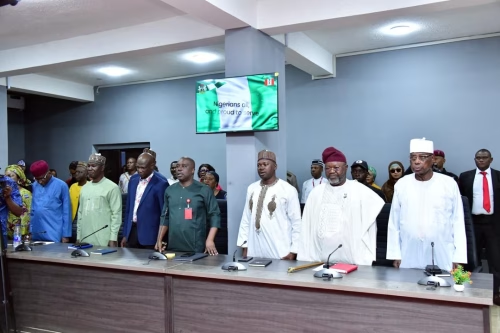
The banquet hall of Government House, Makurdi, was Tinubu’s next destination. He had a townhall interface with top government functionaries; the political class; traditional rulers, and the intelligence and security top brass. Paramount ruler of the Tiv nation, the Tor Tiv, James Ortese Iorzua Ayatse, put the issues surrounding the relentless onslaught on Benue State across sociocultural diversities, in proper perspective. Ayatse a distinguished Biochemist who attained the rank of substantive Professor at 37, and served as Vice Chancellor of two federal universities in Makurdi and Dutsin-Ma, in Benue and Katsina states, demonstrated the stuff of the well grounded scholar that he is. Ayatse frontally addressed the recurring “misinformation and mischaracterisation” of the Benue plague, arguing that “land grabbing is at the core of the decades long conflict.”

The Tor Tiv described the killings in Benue State as a “calculated, well-planned, full-scale genocidal invasion and land-grabbing campaign by herder-terrorists” which has persisted for decades. He dismissed claims that the killings arose from clashes between herders and farmers, describing such suggestions as misleading and misinformation. Ayatse observed: “We have grave concerns about the misinformation and misrepresentation of the security crisis in Benue State. It is not herders-farmers clashes, it is not communal clashes, it is not reprisal attacks or skirmishes. It is this misinformation that has culminated in suggestions such as “remain tolerant,” “negotiate for peace,” “learn to live with your neighbours.” Wrong diagnosis, the Tor Tiv noted, will always lead to wrong treatment. His words: “We are dealing with something far more sinister, than we imagine. It is not about learning to live with your neighbours, it is about dealing with a war situation.”

The Tor Tiv received resounding applause from attendees at the event, who concurred with the succinct, laconic manner he captured the facts of the festering Benue State security challenge, before President Tinubu. The audience included the Secretary to the Government of the Federation, (SGF), George Akume, who was Governor of Benue State between 1999 and 2007. There were also Governors Abdulrahman Abdulrasaq; Caleb Muftwang; Abdullahi Sule; Ahmed Ododo, from the North Central states of Kwara, Plateau, Nasarawa and Kogi. Governors Hope Uzodinma and Lucky Aiyedatiwa of Imo and Ondo states were also present in solidarity with their troubled Benue counterpart. The National Security Adviser, (NSA), Nuhu Ribadu, was present.

The Chief of Defence Staff, (CDS), General Christopher Musa, led other Service Chiefs, notably Olufemi Oluyede, Chief of Army Staff, (COAS); Hassan Bala Abubakar, Chief of Air Staff, (CAS), to the stakeholders meeting. Kayode Egbetokun, the Inspector-General of Police, (IGP), had indeed been in Benue State, days before the President. Federal government functionaries of Benue State origin in attendance included the Minister for Water Resources, Joseph Utsev, a Professor; Executive Secretary of the Tertiary Education Trust Fund, (TETFUND), Sonny Togo Echono; and his counterpart in the Nigerian Shippers’ Council, (NSC), Akutah Pius Ukeyima. Senator Representing Benue North West, Tartenger Titus Zam and the Member Representing Makurdi/Guma federal constituency in the House of Representatives, Dickson Dominic Tarkighir, were equally in attendance.

A better-informed President Tinubu conveyed the condolences of his administration to the government and people of Benue State. He noted he would have been more delighted to be in Benue State to commission projects and infrastructure developed for the collective benefit of the people of the state, than the lachrymal circumstances which compelled his coming. He noted that on no account should cattle be equated with humans, such that humans have to be killed for livestock to be fed. The President called out the IGP, asking him why arrests had not been made. He requested increased collaboration and the intensification of surveillance and intelligence gathering by the Department of State Services, (DSS); the National Intelligence Agency, (NIA) and the Defence Intelligence Agency, (DIA), in apprehending the criminal perpetrators of the Yelewata and Daudu pogrom. The President unwittingly committed a gaffe when he said he aborted his intended assessment visit to Yelewata because of the torrential rain and the state of the road. How about the little children who lined up the streets in the deluge, to receive him? Whose responsibility is it to fix national highways, Yelewata being on the critical Lafia-Makurdi- Otukpo-Enugu road, which links the North Central to the South East and South South?

Tinubu admonished the CDS on the imperative for increased vigilance and synergy with communities to stem needless human hemorrhaging. In an implied critique of Governor Alia, President Tinubu advised him to work with his predecessors, Benue elders, royals, federal government officials and non-indigenes, to share views and opinions towards engendering lasting peace and security. There have been reports of estrangement between Alia and a top federal government official, one of his predecessor, who was substantially instrumental to Alia’s emergence as Governor. The President equally requested the Ministers of Agriculture and Food Security, and Livestock Development, to promptly liaise with Governor Alia, towards the establishment of modern ranches for better animal husbandry.

Let’s hope President Tinubu institutes a multilevel system for filtering authentic intel, different from the monolithic sources of his appointees. The Benue incident has just shown that so much can be kept away from the ears of any leader who does not intentionally cultivate backup information and intelligence sources. This approach served former President Olusegun Obasanjo very well. Let’s hope conversations around the Benue plague will yield suggestions to the practical mitigation of subsisting security problems of the state. Let’s hope these engagements will be broad enough to equally throw up panaceas for other variously troubled parts of the country. Let’s hope the defence and security sector will conscientiously commit its ever bloating budgetary allocations to the pointed procurement of relevant equipment, and the prompt and adequate settlement of troops on the frontlines with their dues and entitlements. Let’s hope technology will henceforth be deployed across theatres of bloodshed in various parts of the country, to nip recurrences that we may have a safe and harmonious nation we all will be proud of.

Tunde Olusunle, PhD, Fellow of the Association of Nigerian Authors, (FANA), is an Adjunct Professor of Creative Writing at the University of Abuja

Benue Bleeds: From a Basket to a Casket


By Halima Abdulazeez


The recent horrors in Benue State are a case of blood in the baskets, when relatives could not recognise their blood as they were burnt beyond recognition. Nigeria is not isolated from the global carnage engulfing our shared humanity. The gruesome loss of lives, the senseless violence, and the brazen disregard for human dignity all echo conflicts raging across the globe, from Ukraine to Palestine, Yemen, Sudan to Iran and beyond. As we mourn the fallen and grapple with the implications of these atrocities, a profound question should reverberate through our collective consciousness: Are we devolving into beasts, driven by primal instincts rather than reason and compassion?


“Man is the harshest animal,” Friedrich Nietzsche once declared, a chilling assessment that seems increasingly related in our turbulent times. The atrocities we witness daily, the calculated bombings, the indiscriminate killings, the systematic displacement of communities. paint a grim picture of humanity descending into barbarism. We are not animals, yet our actions often portray a disturbing descent into animalistic behaviour, driven by greed, power, and an insatiable thirst for domination.

Life is sacred, regardless of nationality, ethnicity, or creed. Whether the victim is a Nigerian farmer slain in Benue State or a child caught in the crossfire in Gaza, each loss diminishes us all. As Albert Schweitzer eloquently stated, “Man has lost the capacity to foresee and to forestall. He will end by destroying the earth.” The ease with which we inflict suffering on one another suggests a dangerous erosion of empathy and a growing indifference to the sanctity of human life. This indifference is better observed on social media, where bloggers’ support are based on religious faction and political affiliation.

Those who revel in the misfortune of others, blinded by tribalism, nationalism, or ideological fervour, should heed the warning: “No one is leaving here alive.” Death, the great equalizer, awaits us all. To celebrate the suffering of others is to invite the same fate upon ourselves. Today it is them, tomorrow it could be you. In a world as interconnected as ours, no one is truly immune to the consequences of violence and instability elsewhere.


Tragically, behind the scenes, “war merchants” are pulling the strings, orchestrating conflicts from boardroom cum war rooms, deciding where the next drone strike will fall.

These architects of destruction, driven by profit and power, treat human lives as expendable pawns in their geopolitical games. Their actions are driven by the corrosive influence of greed and the moral bankruptcy of those who prioritise personal gain over the well-being of humanity.


Even more alarming is the ignorant arrogance with which many take sides, seemingly oblivious to the devastating toll these conflicts exact on the world. The cycle of violence perpetuates itself, fueled by misinformation, propaganda, and a dangerous lack of critical thinking.


We must resist the temptation to blindly support one side against another, and instead, demand accountability from all parties involved and advocate for peaceful resolutions that prioritize human lives above all else.


The influence of “Big Brother,” the superpowers that exploit their dominance to bully weaker nations, is particularly concerning. Their actions set a dangerous precedent, teaching the world that “might makes right” and that international law can be disregarded with impunity. We must resist aggression and champion diplomacy, cooperation, and respect for international norms.


As Martin Luther King Jr. warned, “We must learn to live together as brothers or perish together as fools.” The path forward requires a fundamental shift in consciousness, a rejection of violence, and a renewed commitment to our shared humanity. We must hold our leaders accountable by bringing the ragtag militias and their paymasters to face justice, demand an end to the arms trade, and work tirelessly to promote peace and justice in our communities and across the globe.


©Halima Abdulazeez

She is a poet and the author of the poetry collection “Soul Rants: A Journey from Within.” She is the Communication Officer at the Caprecon Foundation and the Treasurer of PEN International, Nigerian Center, and she resides in Lagos.

Contact: +234-8034816865 (mailto:umuhfaisal@gmail.com)

Police Under My Watch Now Respond To Scene Of Crime Swiftly — CP Lagos


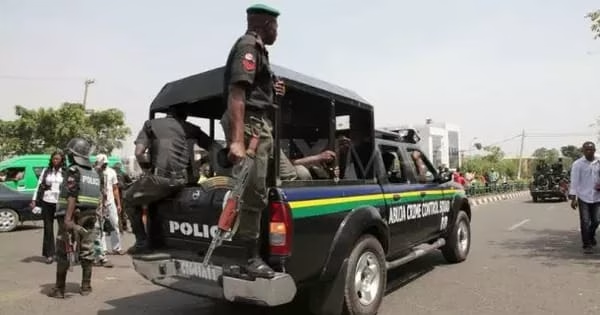
The Commissioner of Police in Lagos State, Olorundare Jimoh, has declared that the state police command now responds to robbery and other public order offences within five minutes of being alerted.

Speaking on Channels Television’s Sunrise Daily programme on Thursday, June 19, Jimoh said the police have significantly improved their response time from under 10 minutes to as little as five minutes.


“Our response time to crime is less than 10 minutes. We have even reduced it further to five minutes. Once you call us, under five minutes, we are there,” he said.


Jimoh assured residents that Lagos is secure, noting that police intervention often prevents crimes before they occur. He added that when incidents do happen, swift detection and response serve as a deterrent to others.


“For those crimes that couldn’t be detected, there is prompt detection to serve as a deterrence to others,” he explained. “For any would-be suspects who want to commit crimes, if you know that once you commit the crime, you would be apprehended, then you would have a second thought about it.”


He further stated that violent crimes in the state are mostly prevented, while the few that occur are quickly addressed by the police.


On the broader issue of Nigeria’s security challenges, Jimoh dismissed calls for state police, arguing instead that increased funding for the Nigeria Police Force is a more effective solution.


“There is no doubt that state police are not the answer to our problem; proper police funding, which the Federal Government has taken upon itself, is the way forward,” he said.

He also pointed out that proponents of state police often overlook examples of successful unitary policing systems. Jimoh said the police have made progress in changing their approach and that traffic robbery in Lagos has been “successfully eradicated.”


Regarding the upcoming local government elections scheduled for July 12, 2025, he said the decision to restrict movement will be made by the Lagos State Independent Electoral Commission. However, he noted that police would act if there were any credible threat to public order during the polls.


“If there is going to be a security threat.

Skills acquisition: Way forward for Nigeria’s educational development 

By Ayo Baje


Quote:

“The future belongs to those who learn more skills and combine them in creative ways.

– Robert Greene


As concerned Nigerians keep deliberating on the best way to navigate the twists and turns inherent in our education delivery system, if yours truly has his way secondary school students should be spending three days of each week for theoretical knowledge and two for practical skills development. These include skills such as tailoring/fashion design, hair dressing and carpentry. Others include building construction, painting, domestic farming, singing, acting, oratory and comedy.


This has become more expedient because in 2023, Nigeria ranked 100th out of 100 countries in Coursera’s Global Skills Report in terms of skill proficiency. Incidentally, the country also ranked low within the Sub-Saharan Africa, placed 12th out of 13 countries.In fact, other African nations such as Botswana and Cameroon outperformed Nigeria in the same report. This was an indication of a significant skills gap in the country. But recent indicators suggest an increase performance that should be built on. For instance, Nigeria showed the fourth-highest year-on-year growth rate for Professional Certificates enrollments on Coursera. This clearly suggests a growing awareness and participation in skills development initiatives which should be built on.


For instance, the unemployment rate in Nigeria stands at about 4.84% in 2025, according to Statista. com. This translates to an estimated 5.74 million people who are unemployed. Similarly, the youth unemployment rate is around 7.50% according to Trading Economics.


Given the current global influence of information technology, the expanding impact of Artificial intelligence ( AI ) and the soaring influence of climate change. Others include the increasing need to ride the freaky waves of economic survival, and the stifling space for employment, not only in Nigeria but across the globe. Yet, the country is abundantly blessed with rare talents in different fields of human endeavour.


Mention names such as Silas Adekunle, known for his robotics expertise and the world’s first intelligent gaming robot or Riya Karumanchi, who invented a device to assist visually impaired individuals the importance of skills acquisition in the development of the talents of our youth gradually dawns on us.


It is a similar scenario when the name of

Hassan and Hussaini Muhammad, who created a way to convert petrol, water, salt, and alum into hydrogen cooking gas crop up. And out there there are other young Nigerian inventors such as Khalifa Aminu (FM transmitter), Muazzam Sani (remote-controlled car), and the team behind the smart walkway light and automatic irrigation. The importance of skills acquisition cannot therefore, be over emphasized.

.


Put in its simple terms, skills acquisition is crucial for Nigerian students academic development, because it enhances their employability, as well as boosts entrepreneurship. In fact, it contributes to overall national development. According to experts on educational development it empowers students to be self-reliant, reduces poverty and unemployment, and also provides them with a global perspective.


The impact and import of students’s skills acquisition is amply deployed in Bells University of Technology, Ota, Ogun state. There, students are exposed to the practical aspect of whatever course they are studying such that seasoned professionals are invited to deliver the practical aspect of their theoretical knowledge.Such is the impact that engineering students have become problem solvers. They have constructed pavements, fences, designed and built solid infrastructure.


Furthermore, the Centre for Agricultural Technology and Entrepreneurial Studies (CATES) has come up as a key initiative at the same university. As a noble cause it was established to foster practical, solution-oriented approaches to agricultural and entrepreneurial development within the university and the wider community. The skills promoting aspect of it is that CATES focuses on areas such as poultry technology, aquaculture, cassava farming, and mushroom culture. It also operates a vegetable farm and a plantain farm on campus. All these explain why graduates of the citadel of knowledge become self employed, with several of them kick starting the process right from the University as undergraduates. All these boost their financial independence while they contribute to the Gross Domestic Product, GDP.


Skills acquisition therefore,

increases employability, more so in today’s competitive job market. Having relevant skills makes students more attractive to employers. These include skills such as digital literacy, communication, and problem-solving, which are highly valued across various industries.Entrepreneurship programs teach them how to start and manage their own businesses. This eventually, leads to economic growth and improved living standards with appreciable Human Development Index, HDI. By equipping students with practical skills, skill acquisition programs can assist to lift individuals and families out of the terrifying trap of poverty and ultimately reduce the unemployment rate for the country.


From the global perspective, many skills are transferable across borders. This is one good lesson learnt from the COVID-19 pandemic. Nigerian students can latch on it to participate in the global economy through remote work or international collaborations. It also fosters confidence in students, assist them to adapt to the global socio-economic dynamics,while instilling a sense of accomplishment in them, thereby contributing to overall personal growth.


Of great significance, is that

a skilled workforce is essential for the nation’s economic growth and technological advancement. Overall, the skill acquisition programs contribute to building a more productive and innovative society. So Nigeria work on the report which highlighted specific skill areas where it lags, especially technology and data science.


Nigeria should also learn from countries that stand out for their high levels of skill acquisition and development. These include Northern European nations such as Finland, Norway, and Sweden which consistently rank high, along with Switzerland, Singapore, and Germany. These countries often prioritize education, training, and creating opportunities for their populations to acquire and utilize a wide range of skills. As rightly noted by Malcolm X: ” Education is our passport to the future, for tomorrow belongs to those who prepare for it today”.

Three kidnappers who collected ₦75m ransom from 10 victims arrested in Edo


Three suspected kidnappers who allegedly abducted 10 victims between January 2024 and April 2025 and collected over ₦75 million from the victims and their families in Edo State are now in police net.

The suspects identified as Asemota Osamede (38), Michael Tomminiwei (43) and Kelly Aitoya (34), belong to a four-man kidnapping syndicate that have been terrorizing Benin City and environs.

They allegedly kidnapped about 10 victims between January 2024 and Aprill 2025, and have collecting over ₦75 million from the various victims and their families.

They, however, met their Waterloo on April 10, 2025, when they kidnapped one Mrs Vivian Diode, who operates a saw mill at Eayan, a suburb community along the Benin-Auchi road, Benin City.

The kidnappers reportedly forcefully collected N1.5 million from her bank account while in captivity and also collected N6 million ransom from her family members before releasing her.

About a week after releasing the victim, the suspects reportedly called the family members again and demanded additional ₦3 million with a threat to kidnap her again or assassinate her if they failed to pay the money.

Following the threat, the family reported the incident to the police and the anti cultism unit of the command swiftly responded and in the process arrested the three suspects.

It was further gathered that during investigation, it was discovered that aside Vivian, the suspects have successfully kidnapped 10 persons and have collected over ₦75 million in ransom between January 2024 and April 2025.

The State Police Command Spokesman, CSP Moses Yamu, who confirmed the incident, said the suspects confessed belonging to a four-man kidnapping syndicate operating with one Ak47 riffle and two pump action gun in Benin City.

He added that investigation has been completed and the suspect would be charged to Court.

“The case concerning the kidnap of Vivian, the suspects have been arrested and investigations completed, they would be charge to Court,” he said.

Substance use prevention in focus as NDLEA, UNODC unveil 2025 world drug day activities. Marwa, Toure call for public , states’ active participation in fight against illicit drugs

By Ebinum Samuel


The Nigerian public has been challenged to get involved and take full ownership of the fight against substance abuse and illicit drug trafficking with a view to curbing the menace and preventing young people from falling into the drug trap.
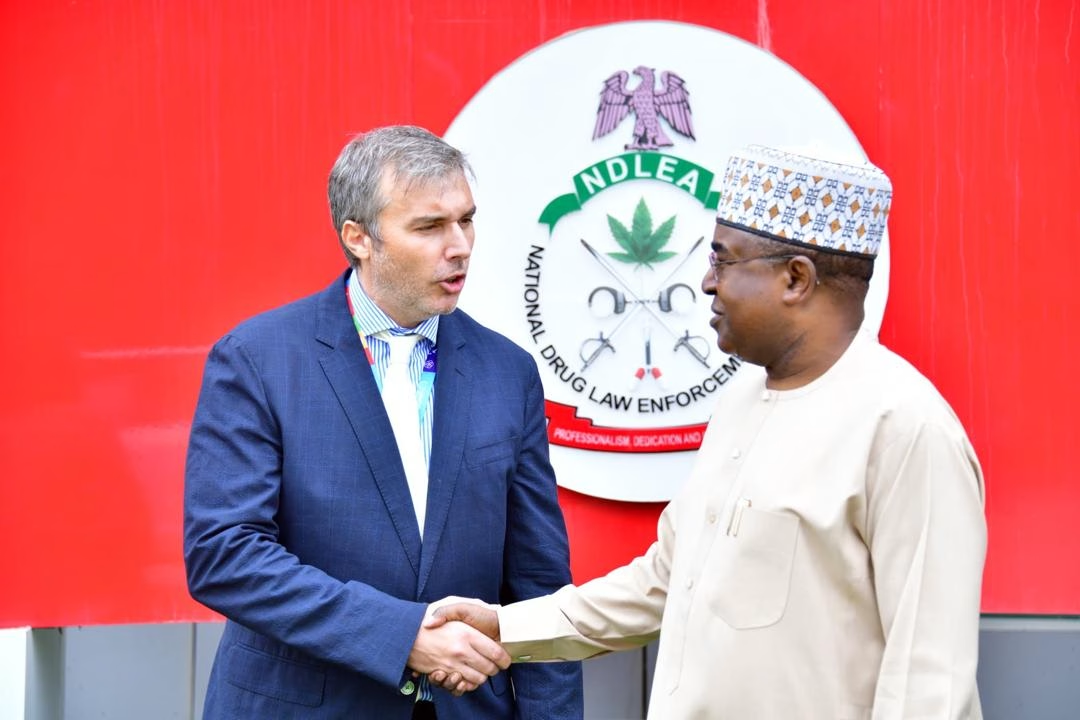
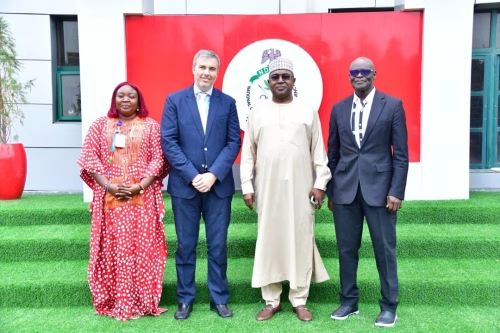
Chairman/Chief Executive Officer of the National Drug Law Enforcement Agency (NDLEA), Brig Gen Mohamed Buba Marwa (Rtd) gave the challenge at a joint press conference with the United Nations Office on Drugs and Crime (UNODC) at the Agency’s National Headquarters in Abuja on Wednesday 18th June 2025 to announce weeklong activities to commemorate this year’s world drug day.
“As we enter another United Nations year focused on prevention, it is vital to stress that the responsibility of shielding our citizens from harmful substances does not rest solely on the shoulders of the NDLEA. It is a collective duty—one that demands the involvement of all, including the general public. On our part, we shall intensify our War Against Drug Abuse (WADA) social advocacy initiatives to further support families, schools, communities, workplaces, places of worship, associations, and trade unions in raising awareness on the dangers of illicit drug use and how to avoid falling victim”, Marwa stated.
He noted that each year, the World Drug Day is guided by a unique theme that shapes the global response to the challenges of drug abuse and illicit trafficking over the following 12 months, adding that this year’s theme “will once again serve as a framework for our awareness campaigns, stakeholder engagements, and community outreach efforts. The theme for this year is: The Evidence is Clear: Invest in Prevention.”
According to him, “We have lined up a variety of impactful activities beginning with today’s press briefing, culminating in the grand finale on 26th of June. These events are designed to raise public awareness, encourage dialogue, and galvanise collective action towards combating drug abuse and illicit trafficking.
“On Friday, June 20, we will hold a Juma’at service at the National Mosque, Abuja. The following day, Saturday, 21st of June at 8am, we will stage a Walk Against Drug Abuse in collaboration with MTN Nigeria Foundation and the University of Abuja at the University campus in Gwagwalada.
“On Sunday, 22nd of June, a Thanksgiving Service will be held at Mountain of Fire and Miracles Ministries Regional Church, Wuye, Abuja, starting at 10 am. We will begin the following week with the final stage of an Essay Competition on Monday, 23rd of June. In this round, schoolchildren will present letters they have written on the theme: “Why I Must Not Take Drugs.” The event will be held at the NDLEA Conference Room at our headquarters in Jahi. The day will also include a range of NGO-led activities focused on drug prevention and youth engagement.
“Our focus on Tuesday, 24th of June, will be on out-of-school youth. To this end, we will conduct an outreach campaign in markets and motor parks across the FCT Area Councils, beginning at 8 am. Finally, on Thursday, 26th of June, which marks World Drug Day, we will hold the grand finale—a commemorative event at the State House Conference Centre, commencing at 9 am.”
He said as part of efforts to address the country’s drug use situation, the NDLEA has also continued on an upward trajectory in terms of arrests, convictions, and seizures.
“We are also modernising our approach to the enforcement of drug laws by embedding innovation in our operations. Notably, the use of body cameras has now been fully integrated into our field activities. Overall, the past year has witnessed significant positive developments in our offensive against drug traffickers and barons.

“In the four and a half years of my leadership, the Agency has been advancing steadily on the path of reform and progress. Earlier this year, in February, we commissioned our first barracks in Yola, Adamawa State. In April, we commissioned both an accommodation facility and a rehabilitation centre in Kano. At present, the barracks in Abuja stands almost ready for commissioning, while the one in Lagos is nearing completion”, he added.
Also speaking at the briefing, UNODC Country Representative, Cheikh Ousman Toure by the Deputy Head of UNODC in Nigeria, Danilo Campisi, emphasized the importance of preventive measures in addressing the global drug use problem. He said “the illicit drug trade is deeply connected to other crimes including human trafficking, illegal mining and environmental destruction. Its proceeds often finance violent extremist groups further destabilizing affected regions. Together these interconnected crimes are part of a vicious circles that entrench poverty, exploitation, institutional weakness and addiction.”

While commending Marwa and NDLEA for doing an excellent work in Nigeria, the UNODC called on state governments to get actively involved in the efforts being coordinated by the NDLEA at the centre. “Stopping drug trafficking requires long-term coordinated action to address supply and demand and prevent organized criminal groups from exploiting vulnerabilities. Most critically, we must involve the sub-nationals, the state governments must be actively involved in drug control efforts working with NDLEA and other relevant entities to ensure the availability of evidence-based preventions and treatment programmes in their states. We will not make significant progress if interventions continue to be centralized.
“This is why UNODC support to Nigeria remains resolute and multifaceted. We are working side-by-side with the government of Nigeria to build forensic and border management capacity to intercept drug flows and strengthen law enforcement capabilities; enhance regional responses to transnational organized crime through training, intelligence sharing and support for joint investigations.
“We stand in solidarity with the Nigerian government, civil society and communities in the fight to dismantle criminal chains, prevent addiction and restore dignity through recovery. We also commend the leadership of NDLEA and the chairmanship of General Marwa whose strategic and courageous efforts continue to make an impact on both supply and demand sides of this crisis. And UNODC is really proud to be a partner of this vital journey.”

‘We’re monitoring the situation’, UN reacts to Benue killings’

The United Nations has reacted to the recent killing of hundreds of residents of Yelewata town in Benue State.

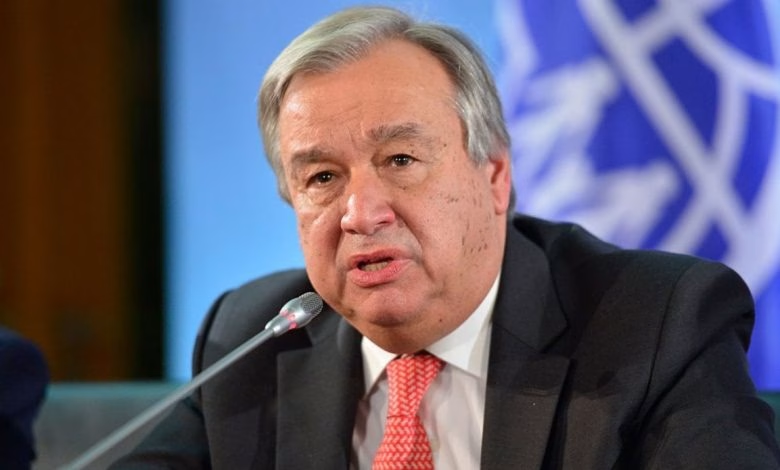
Antonio Guterres, the Secretary-General of the United Nations on Tuesday said the international organisation is currently monitoring the situation of things in Benue State.

In a statement issued by Farhan Haq, the Deputy Spokesperson for the Secretary-General, the UN condemned the incessant killings in the state.

The statement said, “We’re monitoring the situation.”

Haq added that the Secretary-General condemned in its entirety, the killing of innocent civilians by suspected herdsmen.

He also called on relevant agencies and security operatives to work towards ensuring that the perpetrators are brought to justice.

“The Secretary-General condemns the killing of innocent civilians, including in Nigeria, and we hope that those responsible for this violence will be found and apprehended,” the statement added.

Recall that the Governor of Benue State, Hyacinth Alia had accused some politicians based in Abuja of sponsoring the attacks in the state.

According to the governor, these politicians, through back channels are responsible for the growing crisis in the state.

He also alleged that the killers invaded the affected communities through a nearby river close to the area bordering Nasawara state.


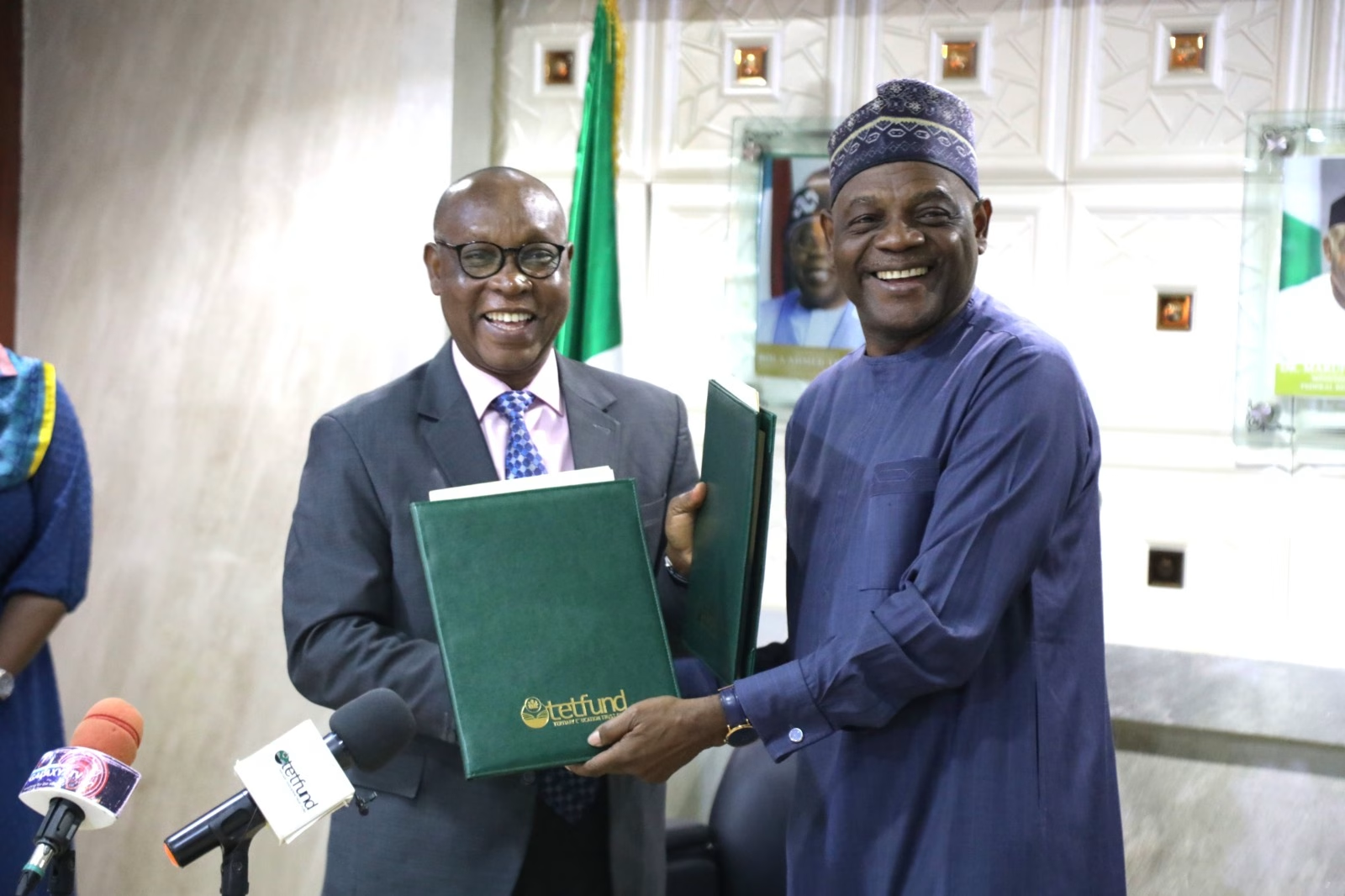
Executive Secretary, Nigerian Extractive Industries Transparency Initiative, (NEITI), Dr Orji Ogbonnaya Orji, (left), and the Executive Secretary of the Tertiary Education Trust Fund, (TETFUND), Arc Sonny Echono, FNIA, OON at the TETFUND Headquarters, Abuja recently


SPECIAL DEDICATION of my READ Initiative to: MRS. ADELINE CRIPE (Nee Adeline Miller) now of blessed memory

Tit-bits:
What is the READ INITIATIVE all about?
READ simply stands for Reviving Early Academic Development. It was conceived in year 2000 after spending 20 years of my career as a school teacher in science subjects.

That was in institutions such as Edeki Grammar School Otuo,( NYSC, 1976-77), in Bendel state(now defunct), Govt. Secondary School, Agbamu, Kwara State, Govt. Girls School, Obangede, (then in Kwara state but now Kogi State), Abdul Azeez Attah Memorial College (AAAMCO,) Okene and Gov. Day Sec. School, Adankolo, Kogi State. It was after all these experiences that I veered fully into the field of journalism.

Furthermore, it was through my experiences in these schools that informed the writing of my motivational bestseller, ‘HOW TO BE A SUCCESSFUL STUDENT’© 2013.
THE VISION is to revive all-round development of pupils and students, at the foundation level of education. One discovered over the years, that many of them fail their examinations not because they are not potentially brilliant but due to lack of good upbringing right from their homes, lack of quality teachers, low teacher-to pupils/students ratio as well as lack of enabling environment for quality education delivery.

These include lack of requisite reading materials, laboratory equipment, practical lessons and lack of focus on their studies as many of them are distracted by societal events and frivolous lifestyles.


So, I go round schools to deliver motivational lectures. And I keep encouraging people to get back to their alma mater to assist in infrastructural development, donation of books, rebuilding school buildings, equipping the libraries and laboratories, in line with the READ Initiative.


** Schools I have delivered such Motivational Lectures, include:
***Victory Group of Schools, Maryland Lagos, Airforce Primary School, Ikeja Lagos, New Erral Group of Schools, Jankara and Progress College, Abule-Egba ,Lagos.


TOPICS of lecture include:
1. Preparing for Tomorrow, Today
2. Bringing Out the Best in You!
3. The Power of Creativity in Students’ Success
4. The Role of Modern Technology in Students’ Development
5. How to Choose the Right Career for You
6. How Drug Addiction and Trafficking Ruins Your future
7. Learning from the Best for Self Development
VITAL INFORMATION:
Parents, Principals and Proprietors who are interested should add me on WhatsApp 07068638066
***REASONS for dedicating the READ Initiative to Mrs. Adeline Cripe ( of blessed memory).
1. She paid my school fees from Form 2 in 1967 to Form 5 in 1970 at Ochaja Secondary School.


2. Apart from teaching the English language she encouraged and honed my writing skill, such that I came up with my first novel as a Form Four student in 1969, though I did it for fun and never got it published.
3. The motivational lessons I gleaned from her and other missionary teachers at that wonderful and all-round developing school who gave my classmates and I all their best must not be lost.