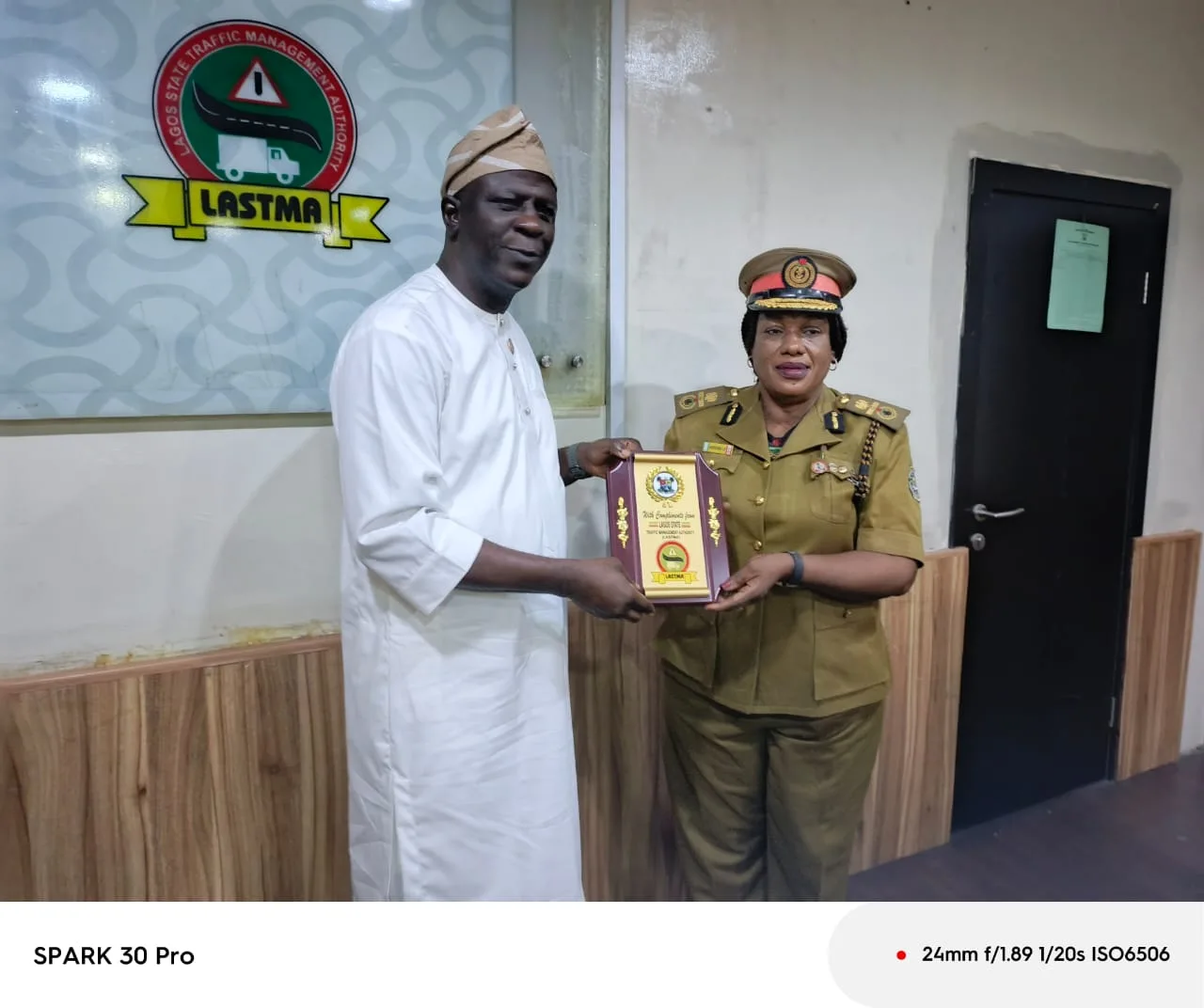
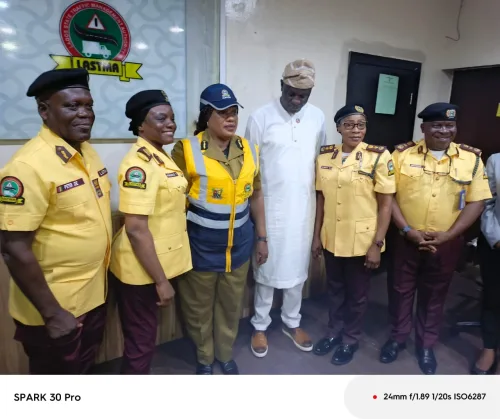
In a decisive move to combat the escalating scourge of drug abuse and its far-reaching implications on road safety, the Assistant Commander General of Narcotics, Archie-Abia Ibinabo, who oversees the Directorate of Operations and General Investigation, Lagos, at the National Drug Law Enforcement Agency (NDLEA), today paid an official visit to the Lagos State Traffic Management Authority (LASTMA) Headquarters in Oshodi, Lagos.During the high-level engagement, the General Manager of LASTMA, Mr. Olalekan Bakare-Oki, was conferred with the prestigious ‘WADA ADVOCACY’ recognition by the NDLEA in acknowledgment of the Agency’s unwavering commitment to drug abuse prevention and public safety.Reaffirming LASTMA’s readiness to forge a formidable partnership with the NDLEA, Mr. Bakare-Oki decried the alarming prevalence of illicit drug consumption, particularly among the youth, and underscored its direct correlation to the rising incidence of road traffic crashes.
He emphasized that reckless driving, often fueled by excessive drug intake, has become a major threat to road safety and public well-being.Furthermore, the LASTMA General Manager exposed the sophisticated methods employed by drug cartels to facilitate the clandestine transportation of narcotics. He revealed that illicit substances are frequently trafficked through unconventional channels such as dispatch motorcycles, ambulances, and other seemingly innocuous vehicles.Stressing the urgency of a synergized response, Mr. Bakare-Oki posited that an intensified crackdown on drug abuse would serve as a linchpin in addressing a myriad of societal challenges affecting the youth, thereby fostering a more secure and orderly environment.In her remarks, Assistant Commander General of Narcotics Archie-Abia Ibinabo reaffirmed that the NDLEA’s visit was a pivotal component of its ongoing sensitization and enlightenment campaign.
She highlighted the indispensability of multi-agency collaboration in the war against drug abuse, particularly with LASTMA, whose jurisdiction over traffic control positions it as a crucial stakeholder in intercepting illicit drug movements.She further articulated that narcotics are predominantly transported via road networks, thereby necessitating proactive intelligence-sharing between LASTMA operatives and the NDLEA. She urged LASTMA officers to remain vigilant and promptly relay pertinent information whenever they encounter suspicious activities linked to drug trafficking during their enforcement duties.According to her, “Many of our youths are currently in rehabilitation centers across the country due to drug addiction. The only way to curb this menace is through a concerted, all-hands-on-deck approach.”This strategic engagement reaffirmed the commitment of both Agencies to a fortified partnership aimed at dismantling drug networks, mitigating the ramifications of substance abuse, and enhancing overall public safety through robust enforcement mechanisms and intelligence-driven interventions.
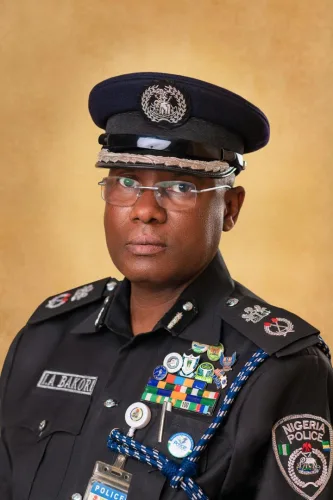
The Police Service Commission has approved the appointment of CP Ibrahim Adamu Bakori, PhD, as the new Commissioner of Police for Kano State. CP Bakori from Katsina State replaces former CP Salman Garba Dogo who has since been promoted to the next rank of Assistant Inspector General of Police. CP Bakori was until his appointment, the Commissioner of Police Homicide, Force Investigation Department, Abuja.
He was a former Commander, Bayelsa State Joint Task Force, Operation Doo Akpo, Yenagoa, Assistant Commissioner SPU, Force Headquarters, Abuja, Assistant Commissioner CID, Bayelsa State; Assistant Commissioner, CID Rivers State; Principal Staff Officer to the Inspector General of Police and Commanding Officer 17PMF, Akure.Meanwhile, the Chairman of the Commission, DIG Hashimu Argungu rtd mni, has charged the new CP to ensure that peace prevails in the state. He said he should quickly settle down to the challenging task before him and also ensure that crime and criminality are brought to an end in the state while promoting freedom of movement and security of enterprise.
According to the Commission’s spokesman, Ikechukwu Ani,DIG Argungu said there was need for him to crime map the state so as to be focused in giving Kano a new lease of life. He promised that the Commission will always monitor his progress and offer support for his success.The Commission’s approval has been sent to the Inspector General of Police for implementation in a letter signed by the Secretary to the Commission, Chief Onyemuche Nnamani
Can Nigeria become a competitive producer and supplier of petroleum products for both domestic and international markets? This question has become increasingly urgent as the country grapples with persistent pricing uncertainties and structural flaws in its energy sector. For Nigeria to harness its full potential in the global hydrocarbon industry, policymakers and energy experts must address the misalignment that continues to undermine growth and stability.
A major challenge lies in Nigeria’s upstream hydrocarbon exploration and production sector, where investment has been inconsistent and poorly managed. The limited funds that have flowed into the sector have often been mismanaged by the state-owned Nigerian National Petroleum Company (NNPC) Limited. Meanwhile, Nigeria’s longstanding upstream joint venture (JV) agreements have become outdated and unattractive to international oil companies, many of which have chosen to exit these arrangements. This structural misalignment has hampered crude oil and natural gas production, affecting both domestic supply and export volumes.
Compounding this challenge is the delay in reforming Nigeria’s petroleum laws. The Nigerian Petroleum Act (1969) remained largely unchanged for decades, and while the Petroleum Industry Act (PIA) of 2021 sought to address this, its implementation has been mired in political interference. Key issues such as the abolition of the petroleum equalisation fund and the long-standing subsidy regime remain unresolved. These uncertainties persist partly because there are no reliable records of petroleum product volumes from NNPC and the Nigerian Midstream and Downstream Petroleum Regulatory Authority (NMDPRA). As a result, policymakers have struggled to develop a transparent, data-driven approach to managing supply and pricing.
Unresolved subsidy claims and equalisation fund entitlements continue to weigh heavily on the national treasury. While these issues are largely domestic and political, they have significantly impaired Nigeria’s investment environment. President Bola Tinubu’s decision to end the fuel subsidy was a bold and necessary move, but years of delay in implementing reforms have left Nigeria trailing behind global industry advancements.
Today, Nigeria faces a critical challenge: balancing domestic energy demands with export commitments. Crude oil production has fallen to an average of 1.6 million barrels per day (bpd), barely meeting the country’s OPEC allocation. This shortfall has made it difficult to supply local refineries with sufficient crude oil and natural gas, further stalling production at facilities such as the Nigeria LNG plant.
Transparency deficits in hydrocarbon accounting, environmental assessments, and community engagement frameworks have also contributed to Nigeria’s energy woes. NNPC’s neglected assets — including oil blocks, refineries, pipelines, and storage depots — have deteriorated, compounding the country’s reliance on imported petroleum products for over two decades. This dependence has distorted Nigeria’s competitive advantage in petroleum pricing.
Despite these challenges, local investors have recognised opportunities within Nigeria’s upstream and midstream sectors. The Dangote Refinery and Petrochemical Complex in Lagos stands out as a major development, alongside notable players such as Seplat, Aradel, Conoil, Aiteo, Waltersmith, Heritage Oil, First E&P, Sahara Energy, and Green Energy. However, these investors have faced significant losses due to bureaucratic bottlenecks and weak regulatory oversight.
The launch of the 650,000 bpd Dangote Refinery has disrupted Nigeria’s long-standing reliance on PMS imports. Yet smaller refineries in Rivers, Imo, and Delta states have struggled to produce enough petroleum products to meet national demand. Meanwhile, the government-owned refineries in Warri, Port Harcourt, and Kaduna have remained largely inactive despite costly rehabilitation efforts. While the recently reopened 60,000 bpd Port Harcourt refinery was celebrated with much fanfare, concerns persist over whether it will ever achieve optimal productivity. The status of rehabilitation efforts at the 150,000 bpd Port Harcourt Refinery, 125,000 bpd Warri Refinery, and 110,000 bpd Kaduna Refinery remains unclear.
Nigeria’s declining crude oil output poses a significant threat to energy security. With an average production of 1.6 million bpd, there is barely enough crude to meet both local refinery needs and international supply agreements. The Federal Government’s recent approval of the “naira-for-crude” scheme, which aims to allocate 450,000 bpd to local refineries, is a step in the right direction. However, compliance with this directive remains fragile. Without sufficient domestic crude supply, the Dangote Refinery may be forced to source crude internationally and pay in US dollars. This would ultimately lead to PMS being priced in dollars, undermining the potential benefits of the naira-for-crude scheme.
Such an outcome could worsen Nigeria’s economic challenges, with potential consequences for the naira’s stability — a situation reminiscent of Kenya’s recent currency crisis. To avoid this, the Federal Government must engage with the Dangote Group and other local refiners to establish a clear supply transition timetable. Critical incentives must be provided to ensure sustained production, and both parties must uphold their commitments.
Nigeria’s energy security depends on aligning domestic production with consumer demand while maintaining favourable export conditions. Ongoing tensions between the Dangote Refinery, NNPC, and petroleum importers reflect a fragile cooperation that, if left unresolved, could deter future investment. Price competition is healthy in a robust supply environment, but allowing low-quality PMS imports to undermine local refiners risks damaging the sector’s growth.
The Dangote Refinery, operating at full capacity, has the potential to meet Nigeria’s entire petroleum product demand with surplus for export. However, unless crude oil supply to local refineries is stabilised, Nigerians may fail to benefit from the competitive pricing Dangote’s scale promises.
Resolving these structural issues requires urgency. Nigeria’s energy sector cannot thrive without clear policies, accountable institutions, and a coordinated effort to support local refiners. Only then can Nigeria secure competitive pricing for petroleum products and protect consumers from prolonged economic hardship.
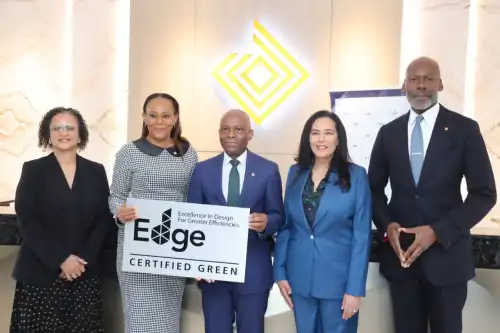
The EDGE Green Building certification program, supported by the Japan Government in Nigeria and globally funded by the UK Government’s Department for Energy Security and Net Zero (DESNZ), with initial funding from Switzerland’s State Secretariat for Economic Affairs, SECO, recognises Access Bank’s commitment to sustainable building practices and its efforts to reduce energy consumption, water usage, and embodied carbon in building materials.
Access Bank’s Head Office has achieved a 20per cent reduction in energy use, a 33per cent reduction in water use, and a 99 per cent reduction in embodied carbon in materials.
The building features sustainability measures such as insulated roof, high-performance glass, fresh air pre-conditioning system, smart meters for energy, water-efficient faucets in bathrooms and kitchen, efficient water closets and low embodied carbon materials reflecting Access Bank’s commitment to environmental responsibility.
The building implemented retrofits to meet the EDGE water standard by installing flow regulators in all their water closets, faucets and showers.
These reductions in energy, water, and embodied carbon are expected to result in significant cost savings and a reduced environmental footprint for the Head Office.
Commenting on this feat, Gregory Jobome, Executive Director, Risk Management at Access Bank, said:
“At Access Bank, we have always understood that our purpose goes far beyond banking.
We are architects of change, custodians of the future, and now, we stand proudly at the intersection of finance and environmental leadership.
This building and this certification embody our vision to set a new standard for building, operating, and growing responsibly.
“Our collaboration with the EEN team was transformational, and together, we have shown that environmental performance and business performance are not rivals, but partners.
We believe that in that partnership lies the future of banking, the future of corporate Africa, and ultimately, the future of our planet.”
The EDGE certification is a globally recognised standard for green buildings, designed to make buildings more resource efficient.
The certification process involves a rigorous assessment of a building’s design and construction, including independent third-party audits, ensuring that it meets the highest standards of sustainability.
IFC’s EDGE program aims to promote green building practices globally by providing a standardised approach to designing and certifying resource-efficient buildings.
The program has been utilised in nearly 200 countries, with over 100 million square metres in certified floor space, enabling developers worldwide to create buildings that reduce energy use, water consumption, and embodied carbon.
Globally, IFC collaborates with financiers, governments, developers, and building owners to accelerate green building development in emerging markets.
In Nigeria, cumulatively, over 800,000 square meters of offices, homes, hospitals, retail stores, student accommodation, hotels, and mixed-use projects are EDGE-certified.
About IFC
IFC — a member of the World Bank— is the largest global development institution focused on the private sector in emerging markets.
We work in more than 100 countries, using our capital, expertise, and influence to create markets and opportunities in developing countries.
In fiscal year 2024, IFC committed a record $56 billion to private companies and financial institutions in developing countries, leveraging private sector solutions, and mobilising private capital to create a world free of poverty on a livable planet.
For more information, visit www.ifc.org.
Stay Connected with IFC on social media
About EDGE
An innovation of IFC, EDGE helps property developers to build and brand green in a fast, easy and affordable way.
EDGE is supported by free software that offers up solutions to reduce energy, water, and the energy embodied in building materials by at least 20 percent.
EDGE certification is recognised by the major green finance standards and streamlines green debt reporting requirements.
The simplicity and low cost of EDGE, plus its focus on quantifying emission reductions makes it invaluable to map and track a path to zero carbon.
The program has been generously supported by the following donors: The United Kingdom, Austria, Canada, Denmark, ESMAP, EU, Finland, GEF, Hungary, Japan, the Netherlands, and Switzerland. For more information, visit www.edgebuildings.com.
About Access Bank
Access Bank, a wholly owned subsidiary of Access Holdings Plc, is a leading full-service commercial bank operating through a network of more than 700 branches and service outlets spanning 3 continents, 24 countries and over 60 million customers.
The Bank employs over 28,000 people in its operations in Africa and Europe, with representative offices in China, Lebanon, India, and the UAE.
Access Bank’s parent company, Access Holdings Plc, has been listed on the Nigerian Stock Exchange since 1998.
The Bank is a diversified financial institution which combines a strong retail customer franchise and digital platform with deep corporate banking expertise, proven risk management and capital management capabilities.
The Bank services its various markets through three key business segments: Corporate and Investment Banking, Commercial Banking, and Retail Banking.
The Bank has enjoyed what is arguably Africa’s most successful banking growth trajectory in the last 20 years, becoming one of the continent’s largest retail banks.
As part of its continued growth strategy, Access Bank is focused on mainstreaming sustainable business practices into its operations.
The Bank strives to deliver sustainable economic growth that is profitable, environmentally responsible, and socially relevant, helping customers to access more and achieve their dreams.
The Bank is dedicated to empowering small and medium-sized enterprises (SMEs) through its profound understanding of customer needs and its unwavering commitment to supporting business growth.
With over 170,000 SMEs supported to date, Access Bank embodies its mantra, ‘We Love SMEs’, by continuously enhancing services and fostering business development.
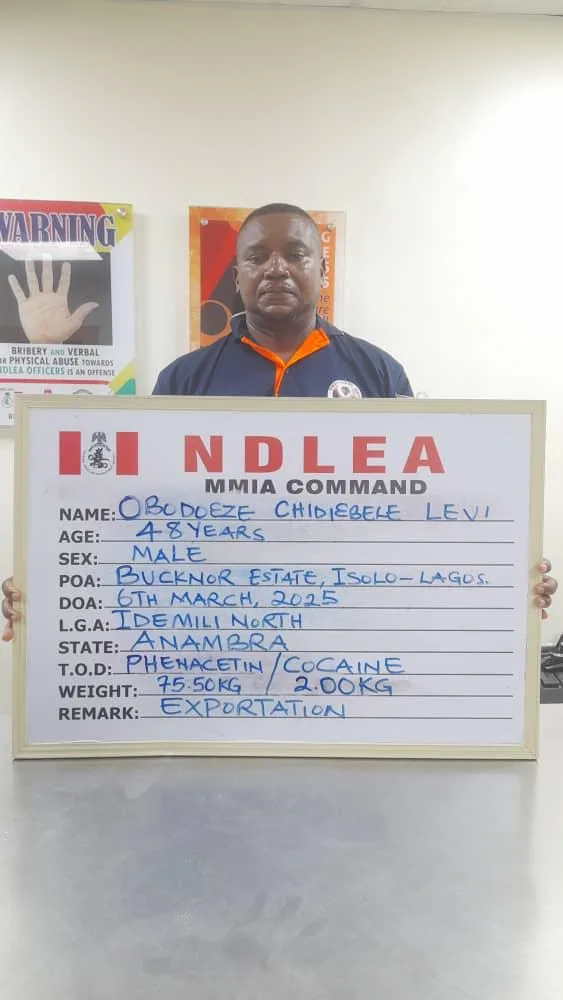
Barely three weeks after launching a manhunt for him, operatives of the National Drug Law Enforcement Agency, NDLEA, have arrested an automobile spare parts dealer Levi Chidiebele Ubodoeze over a recent attempt to export two kilograms of cocaine concealed in vehicle propellers to Angola.Following the seizure of the cocaine consignment at a logistics company in Aspanda, Trade Fair Complex, Ojo area of Lagos on 21st February 2025, swift contacts were made with Angolan authorities who in turn arrested the supposed recipient of the illicit drug in Angola, after which the identity of the sender was unraveled.As a result, NDLEA operatives on Thursday 6th March tracked Ubodoeze to his house in Ago palace way area of Isolo, Lagos where he was caught in a KIA Sport Utility Vehicle trying to escape. A search of the vehicle led to the recovery of a large quantity of phenacetin, a cutting agent for cocaine weighing 75.50 kilograms packaged and branded as semolina, while a digital scale used in weighing illicit drugs was recovered from his house. In his statement, Ubodoeze admitted dealing in cocaine while selling motor spare parts at Ladipo market, Mushin area of Lagos.
He stated that the supposed recipient of the illicit consignment in Angola alerted him the moment he was arrested in Angola hence his bid to evacuate his house and flee from the area shortly before NDLEA officers swooped on him.Meanwhile, NDLEA operatives at the import shed of the Murtala Muhammed International Airport, MMIA, Ikeja Lagos have intercepted a cargo of cannabis candies imported from the United Kingdom and meant for sale at a Kiddies Mart, located at 46 Ogunlana drive, Surulere, Lagos.The consignment was seized on 27th February upon its arrival as a consolidated cargo on Allied Airways. Preliminary field test and subsequent forensic analysis of the candies established that the substance was laced with a strong strain of cannabis. As a result, the recipient of the shipment, Adedamola Taylor, was arrested on Tuesday 4th March after initial arrest of a freight agent.In his statement, Adedamola claimed the consignment was sent to him by his UK-based brother Babatunde Alabi, to deliver to one Musurat Lawal, who operates the Kiddies shop owned by Alabi in Surulere area of Lagos.
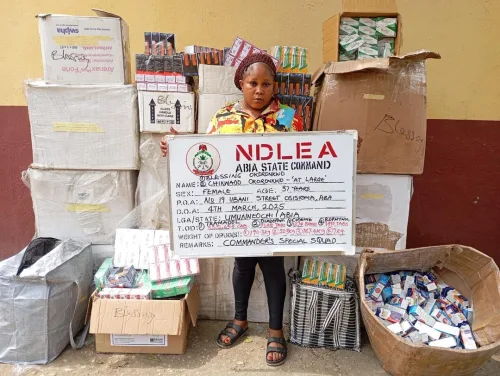
A follow up operation at the shop led to the arrest of Musurat. Two suspects: China Michael and Igbo Ekene were arrested on Friday 7th March when their commercial truck was intercepted by NDLEA operatives at Shibiri area of Ojo, Lagos. A search of the vehicle revealed 248 compressed blocks of Ghanaian Loud, a strain of cannabis, weighing 128kg, were concealed in the underbelly of the truck.In another interdiction operation in Lagos, three suspects: Osinachi Nwachukwu; Tochukwu Okafor Christian and John Ugochukwu Mbakwe were on Friday 7th March arrested at Mosalasi junction, Mushin, with 301,600 pills of tramadol and other opioids.In Kano, 65-year-old Yahaya Haruna was nabbed with 19.2kg skunk along Gadar Tamburawa road on Thursday 6th March while 60-year-old Musa Bello (a.k.a Jajere) was arrested with 212 bottles of codeine-based syrup at Medile, Kumbotso local council area.No fewer than 442,594 pills of tramadol and other opioids as well as 1,274 bottles of codeine syrup were recovered by NDLEA operatives who raided the house and warehouse of a 37-year-old suspect, Blessing Okoronkwo at 19 Ubani Street, Aba, Abia state on Tuesday 4th March.
In Benue state, 50,000 pills of tramadol and exol-5 were recovered from two suspects: Nwaeze Onyeabor, 47, and Tombo Thomas, 23, on Wednesday 5th March when their vehicle was intercepted by NDLEA operatives at Ugbema junction, Katsina Ala area of the state.In Osun state, a suspect, Asimiyu Muibi, 50, was arrested on Tuesday 4th March with 162kg skunk at Modakeke, Ife East local government area while 95kg of same substance was recovered from a Toyota Camry car marked KSF 72 GW during a raid in Ede same day.A suspect, Etim Esien Stephen, 55, was arrested when NDLEA officers on Wednesday 5th March raided the Amahor community forest, in Igueben area of Edo State where 9,514.625kg skunk was destroyed on 3.805846 hectares of cannabis farm land. With the same vigour, Commands and formations of the Agency across the country continued their War Against Drug Abuse, WADA, sensitization activities to schools, worship centres, work places and communities among others in the past week.
These include: WADA sensitisation lecture to students and staff of Model High School, Amaechi, Enugu; Bengy Secondary School, Agege, Lagos; Sunshine Secondary School, Nku Udo Eno, Akwa Ibom; and Government Day Secondary School, Dong, Adamawa state, among others.While commending the officers and men of MMIA, Lagos, Kano, Abia, Benue, Osun and Edo Commands of the Agency for the arrests and seizures, Chairman/Chief Executive Officer of NDLEA, Brig. Gen. Mohamed Buba Marwa (Rtd) stated that their operational successes and those of their compatriots across the country especially their balanced approach to drug supply reduction and drug demand reduction efforts are well appreciated.
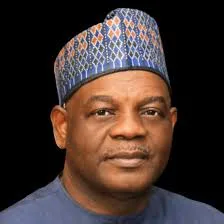
One very well reasoned appointment into a very critical government department in recent years, is bound to be the “conscription” of Sonny Togo Echono to the leadership of the Tertiary Education Trust Fund, (TETFUND). The last five years of his most eventful public service career were spent as Permanent Secretary in the Federal Ministry of Education. On a daily basis, he engaged with Vice Chancellors, Rectors and Provosts of Universities, Polytechnics and Colleges of Education, owned by the federal government. Added together, we are speaking here of well over 100 such institutions, with the federal government hosting this tripod of institutions, universities, polytechnics and colleges of education, in most of the 36 states and the Federal Capital Territory, (FCT).
Echono’s office distilled the needs of these citadels of knowledge and activated the bureaucracy of the ministry to tend to their operational requirements.Following his retirement from service early 2022, Echono momentarily reclined into his couch to savour desired rest and rejuvenation after a racy and most eventful career. Before his last port of call in the Federal Ministry of Education, Echono’s career which began as an architect with the Federal Ministry of Works and Housing in 1987, had taken him through several key Ministries, Departments and Agencies, (MDAs), availing him multisectoral experiential rootedness across the public service. He had served variously in the Budget Monitoring and Price Intelligence Unit, (BMPIU), and the ministries of Defence; Water Resources; Environment; Agriculture and Power. He had therefore planned to shuttle between his address in Nigeria’s capital city and his countryside abode in the Idoma heartland in Benue State, which he cherishes dearly.Duty, however, beckoned within weeks of his retirement. Echono, seasoned architect, experienced public servant, consummate patriot, was appointed Executive Secretary of TETFUND. He formally assumed office on March 18, 2022.
The scheme was established by the federal government in 2011, with the primary responsibility of disbursing, managing and monitoring the deployment of education tax remitted to government-owned tertiary institutions in Nigeria. Public tertiary institutions were hitherto poorly funded. This situation, expectedly, had very negative impact on knowledge dissemination, periodically engendering unrest in the institutions. TETFUND is supervised by the Federal Ministry of Education, Echono’s last official post. This naturally has ensured smooth and seamless collaboration between the parent ministry and its parastatal, since the onset of the Echono dispensation.Three years into his five-year stewardship, Echono continues to chalk up milestones for the organisation.
It was not going to be “business as usual” under his watch so he began with desirable “housekeeping” by addressing the work ethic in TETFUND. Previously perceived as a “cash cow,” entrenched interests had constituted themselves into a cabal which determined the award of contracts to predetermined interests. There were also murmurs and talks about stealing and underhand dealings which cast the organisation in bad light in the public sphere. Steeped and stewed in the ethos of due process and public procurement, Echono moved speedily to bring his imprimatur to bear on the workings of the organisation. He has since striven, gradually and unobtrusively, to straighten the administration of TETFUND and realign its operations with its core mandate.Such revolutionary novelties in an organisation previously steeped and stuck in its ways were not going to make new friends for Echono. Fifth columnists in the system and their external collaborators, periodically engineered phoney petitions to anti-graft agencies, notably the Independent Corrupt Practices and Related Offences Commission, (ICPC). They equally generated submissions to the nation’s parliament contending in one particular instance, that an accumulated allocation of over N2 Trillion to TETFUND over the years, could not be accounted for! The ever calm Echono has always responded to such claims and invitations to clarify the issues with impeccable documents and records.
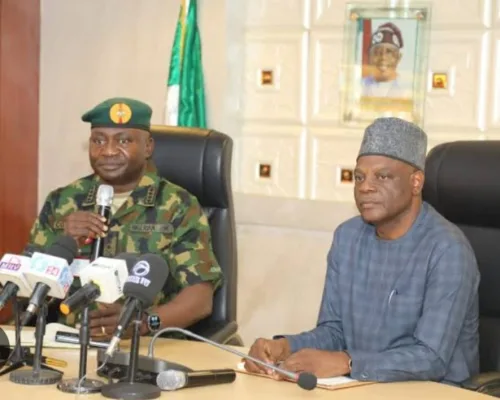
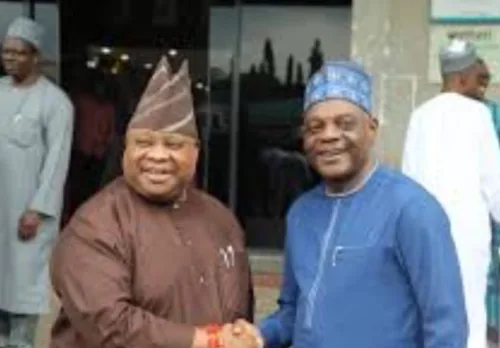
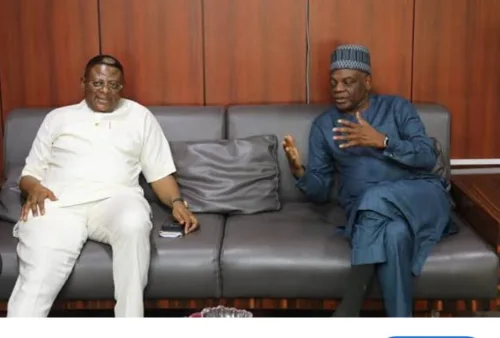
These have serially deflated the schemes and mischief of faceless rabble rousers. Sonny Echono’s regime has brought a fresh air of activism into the endeavours of TETFUND. The federal government has also continued to reaffirm its faith in the establishment via regular upward reviews of its budgetary allocations. TETFUND continues to renew, or open fresh, possibilities for collaboration between it and a plethora of organisations. Callers at the Abuja headquarters of the organisation over time, have included the Senate and House Committees on Tertiary Institutions. Governor Ademola Adeleke of Osun State and his Cross River State counterpart, Bassey Otu, have also visited TETFUND seeking partnership. Nigeria’s Chief of Defence Staff, (CDS), General Christopher Gwabin Musa has also been a guest of Echono’s TETFUND. Musa exercises oversight over the Nigerian army, navy and airforce. Over the years, the military has continued to reinvent its training institutions many of which are degree awarding citadels today. Musa believes there are areas of potential cooperation between the military and TETFUND, and has begun a conversation around this. The Federal Road Safety Corps, (FRSC), recently followed the precedence of the military, when its Corps Marshal, Shehu Mohammed, led a team to TETFUND. The FRSC canvassed support for its training institutions to enhance the capacity and professionalism of road safety personnel across the country. Simultaneously, Echono is regularly on the road with his own officials, knocking on doors of MDAs whose partnership can strengthen the enterprise of TETFUND.
Ademola Adeleke, Governor of Osun State being received by Sonny Echono during his visit to TETFUND.
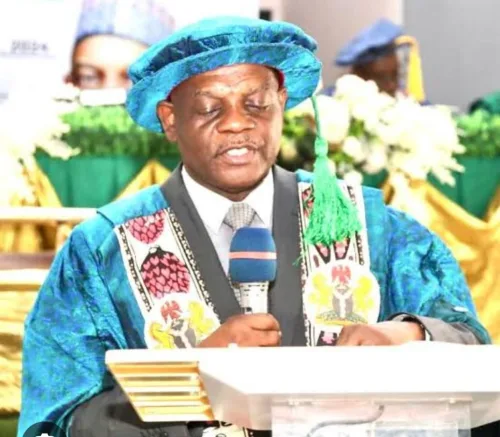
Among several others, he has in recent months, led delegations to the Economic and Financial Crimes Commission, (EFCC), and the Nigerian Extractive Industries Transparency Initiative, (NEITI). Echono is equally a much sought-after speaker these days at university convocation lectures and similar public engagements. These have availed him the platform to address burning issues in Nigeria’s all-important educational sector. Echono’s Convocation Lecture at the Federal University of Technology, (FUTO), Owerri, Imo State, last December, was titled *Impact of Leadership Selection on Governance in Public Universities in Nigeria.* At a similar event at the Olabisi Onabanjo University, (OOU), Ago-Iwoye, Ogun State last January, Echono spoke on *TETFUND and Educational Development in Nigeria: The History, the Treasures and the Future.* Echono addressed the subject *University Autonomy and the Challenge of Quality Tertiary Education in Nigeria,* at the Convocation ceremony of the Federal University Oye-Ekiti, Ekiti State, in February. He has deployed these speaking opportunities to address issues of inadequate funding in tertiary institutions, and to restate the imperative of the payment of tuition fees in public universities. This, he has regularly maintained is crucial to support that critical level of the educational hierarchy. Echono has canvassed synergy between institutions in the areas of research, innovation, alumni obligations and student exchange to broaden the worldview of young scholars. He has equally admonished on the inescapability of full autonomy in public universities, if educational standards must improve and be sustained. The acquisition of quality literacy never comes cheap, he has consistently maintained.
Elsewhere, Echono has decried the penchant of many Nigerians who were sponsored abroad on public resources, but refusing to return home to contribute to national development. Many such nationals opt to stay back in foreign lands, against the spirit of their scholarships. Echono regards this as a dimension of the pervading *japa* syndrome, the abscondment abroad of Nigerians fleeing excruciating socioeconomic conditions at home. Last November, TETFUND under Echono stopped government funding for intending foreign students. This should mitigate the double-sided loss of the country’s fiscal and human resources, respectively. At an August 2024 *Conference on Digital Pedagogy and Fundable Research Writing,* Echono criticised the arbitrary upgrading of Colleges of Education into Universities of Education, by governments at various levels. His contention is that the country remains in short supply of teachers and instructors at the foundational level of education. Sonny Echono has also criticised the continuing politicisation and corruption inherent in the appointment of Vice Chancellors in Nigerian universities. In one of his public presentations, he abhorred political interference and financial inducement in leadership selection processes in our universities.
These factors he observed are combining to erode the sanctity of the hallowed university system. Echono expressed worry about the fact that competition for appointment into principal offices in universities has become a lucrative venture which has made members of governing councils prone to fiscal inducement. Echono has received several awards through the years including that of the national honour of *Officer of the Order of the Niger, (OON).* He has demonstrably distinguished himself beyond the the half line of his present assignment. He can be trusted and should be continually supported to consolidate on his legacies in the years to come.
Tunde Olusunle, PhD, Fellow of the Association of Nigerian Authors, (FANA), is an Adjunct Professor of Creative Writing at the University of Abuja*
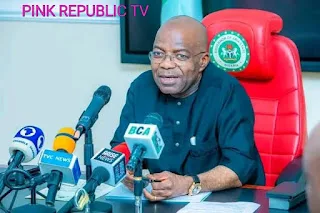
The Abia state government has issued a stern warning to building developers, stating that it will no longer approve the construction of three-storey buildings without elevators. This move aims to ensure that buildings in the state are safe, habitable, and meet standard practices.According to Architect Uche Ukeje, General Manager of the Greater Aba Development Authority (GADA), the strict implementation of building control measures will eliminate building collapse, protect lives and properties, and promote environmental friendly buildings.
The government has emphasized that all storey buildings with three floors must be fitted with elevators. Developers must also obtain necessary approvals before commencing construction and ensure stage-by-stage monitoring and supervision of building projects.New Building Regulations:- _Elevator Requirement_: All three-storey buildings must have elevators.- _Drainage and Waste Disposal_: Developers must submit plans for drainage and waste disposal, which must be approved before construction begins.- _Environmental Protection_: GADA is working with environmental health officials to arrest and prosecute individuals who destroy the environment.
The Abia government has digitalized its operations, allowing developers to track the status of their projects online. Failure to comply with these regulations may result in arrest, prosecution, and project shutdown.¹
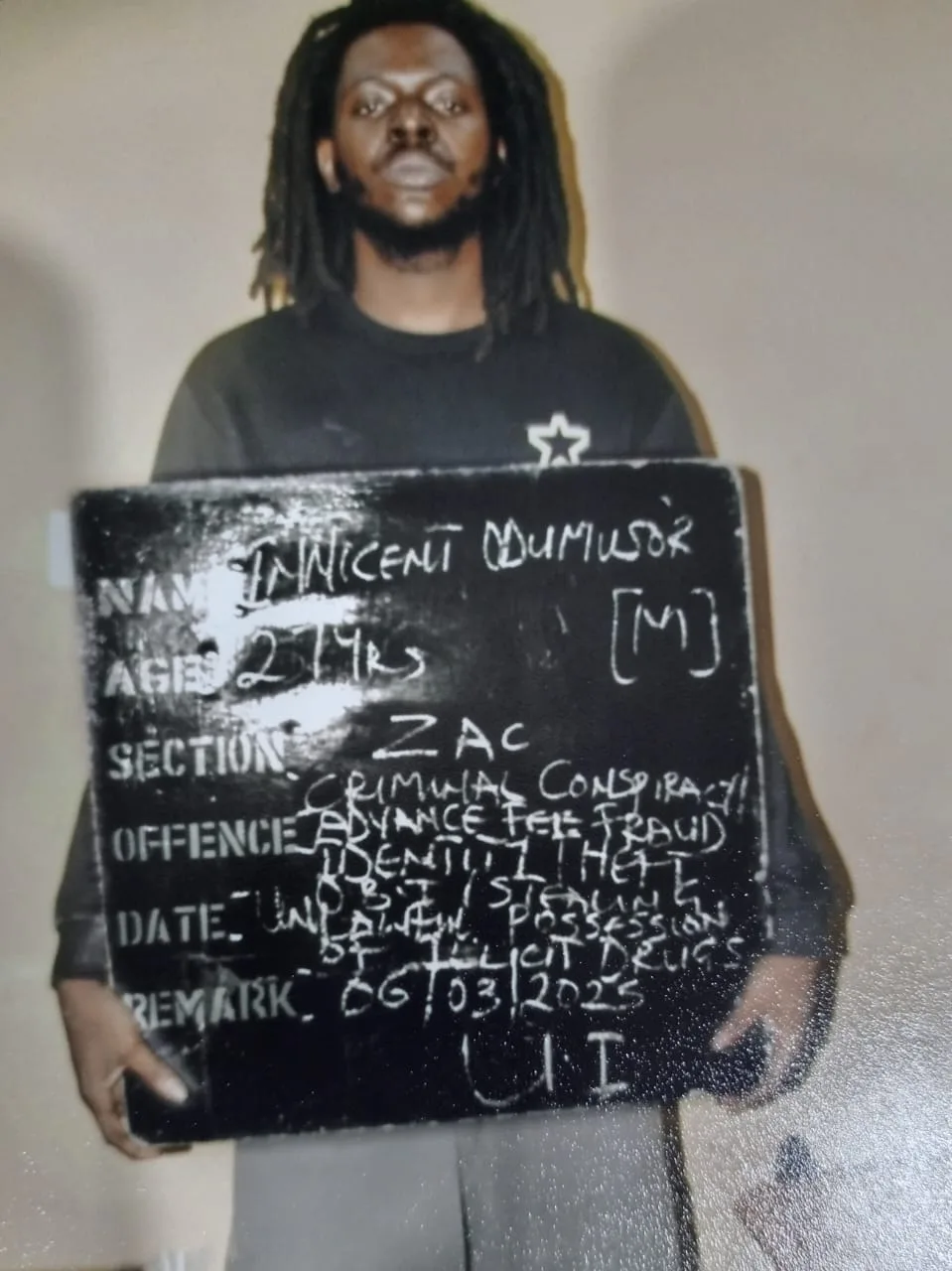
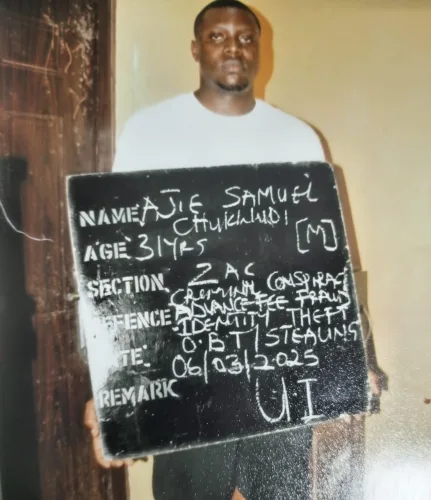
The police in Lagos, weekend, arrested three suspects alleged to specialize in forging international bank cheques by impersonating foreign celebrities. The suspects: Innocent Odumosor, 27, Ajie Samuel Chukwudi, 31, and Godwin Divine, 19, were arrested at their residence in Lagos after detectives attached to Anti-Corruption Unit, Zone 2, Onikan, Lagos recieved intelligence reports about their criminal activities with other members of the syndicate based abroad.The ring leader of the syndicate, Innocent Odumosor lives in a four bedroom flat at Ocean Freeze Estate, Ologoro, Ikate, Lagos while his second in command, Ajie lives at Star Times Estate, Ago Palaace Way, Lagos.Both the ring leader of the syndicate and his second in command reportedly confessed to have made about N400m each since they started the fraudulent business in 2021.
It was learned that during interrogation, the suspects confessed to the crime and gave vivid details of their criminal exploits, which involves impersonating notable foreign celebrities and defrauding Bank of America of millions of dollars. According to their ringleader, Innocent Odumosor, a graduate of the University of Cross Rivers State, we buy ‘tools’ from Xeet.com, which we use in commiting the crime. According to him, tools work as software and we buy from the site.”It works with the software of different foreign banks. We clone cashier cheques and contact other members of the syndicate overseas to source for foreign accounts where they can log in the cheques. “The victim unknowingly cash the cheque and send it to the account our syndicate will provide.
The victims are randomly chosen and engaged in long chats before we strike. We normally load the account, and the victim will be chatting with any member of the syndicate resident abroad.”Police investigation uncovered that after they received proceeds of their latest exploits on March 28th, 2025, the ring leader acquired a Mercedes 223 GLE valued at N250m while his second in command also bought Mercedez GLE 221 worth N150m. Share of the third suspect is said to still be cooling off in his bank in Nigeria.
The ring leader said that he graduated in 2019 and started internet fraud in 2021. According to him, I learned how to do it through online and websites like: Xeet.PW and Monove.com. I specialize in loading of foreign bank accounts by buying loading tools from different websites such as Olux.TO, Monove.com, and Cheap.com at different prizes ranging from $10 to $100. I get different foreign bank accounts from other members of the syndicate and I load money into the account. The foreign banks are mostly in USA. We share proceeds of our loot 50/50. The latest transaction I had with Ajie eas that of $350,000 cash cheques from Bank of America and the beneficiary is Babara Franks. I got $150,000 as part of my share using my Access bank and it came to be N230m.
I used part of it to buy Mercedes GLE worth N120m and used the remaining to take care of myself, my family, and my music career. I use my I-Phone 16 Promax and Labtop to do the deals. I pay N10m for my four bedroom flat at Ocean Based Estate at Ikate.”The second in command, Ajie Samuel aka Pappy, a native of Delta State and a Mechanical Engineering graduate from Cross Rivers University said he got $50,000 from their deal stating that he was a middle man during negotiations. It was gathered that detectives are collaborating with the International police with a view to rounding up other members of the criminal syndicate based abroad and that they have already confiscated international passports of the suspects.
They are also said to be beaming their seachlight on all the banks connected with the activities of the suspects with a view to ascertaining if there is internal connivance or not. When contacted, the Assistant Inspector General of Police in charge of Zone 2, Adegoke Fayoade confimed the arrest of the suspects stating that investigations are still on.
Representatives of the 197 police officers recently retired by the Police Service Commission, PSC, over “attainment of 60 years of age and 35 years of service” have debunked some misleading media reports alleging that they were sacked over corruption, forgery, overstayed and falsification of age. Rising from a meeting held at the nation’s capital, Abuja, last weekend, some of the affected police officers retired compulsorily last month by PSC said the issue the authority claimed to have retired them for is strictly on regularisation of first date of entry which various courts has settled. One of the aggrieved retirees who pleaded anonymity, said: “The truth about our case ( Courses 18,19 and 20) is all about when we ought to be due for retirement from the Force as Force Entrants. It has nothing to do with corruption, forgery, overstayed or age falsification. What actually happened to our compulsory retirement is a policy somersault” Speaking further, he disclosed that their grievances are all about the somersault by the same PSC that in 2017 ordered the then Inspector-General of Police, IGP, to implement an Appeal Court ruling on the case of date of appointment. “To our dismay, some reporters, in their unverified reports have tarnished our image by alleging that we were sacked over corruption and other vices”,said the retiree. One of the affected officer, a retired Chief Superintendent of Police (CSP), who also pleaded anonymity, enjoined reporters to cross-check facts before rushing to publish their stories. According to him, such unverified reports have done a lot of damage to several families. He stressed: “The issue we had with PSC has been clarified by the Appeal Court in 2017. We believe that PSC is not the Supreme Court of Nigeria”. When asked to throw some light on the policy somersault, one of the officers explained that in 1989 during the administration of Alhaji Mohammadu Jimeta Gambo as the Inspector-general of Police, IGP, there was a policy that Non- Commissioned Officers, NCOs who got university degrees and were desirious of becoming senior police officers of Assistant Superitendent of Police, ASP, would be deem by the police authority to have resigned and to start afresh from the date they were appointed as officers. This, by implication, means that such officers date of entry into the force will start from when they were appointed as officers not when they enlisted as constables. The officer revealed that an attempt was made some years later by another police authority to reverse it. This , he said led to some of the beneficiaries of force entrants (included) are those of courses 18,19 and 20 to challenge this at The Industrial Court of Nigeria in Abuja Judicial Division in suit nos NICN/ABJ/345/2019 and NICN/353/2019.The judgement delivered on the 13th January 2021 in the suits, according to him, was in their favour . He disclosed that the decision by the PSC to order the IGP to retire them without recourse to due process has led to series of embarrassment to them and their families. They averred that they are being punished for a policy they never initiated.
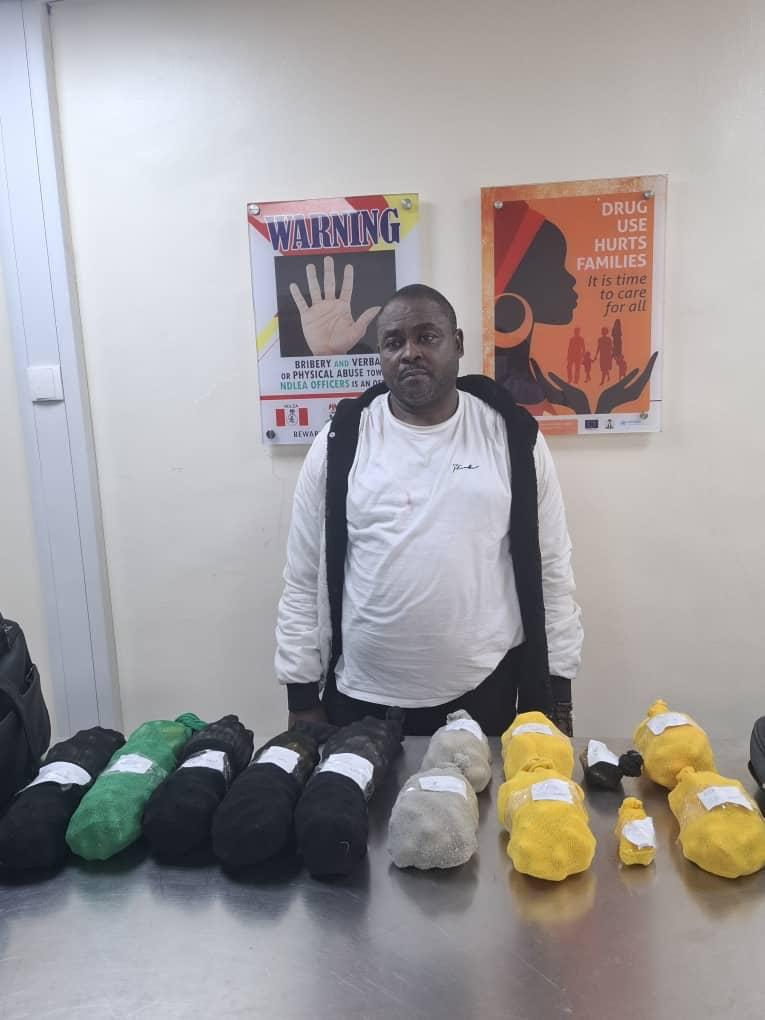
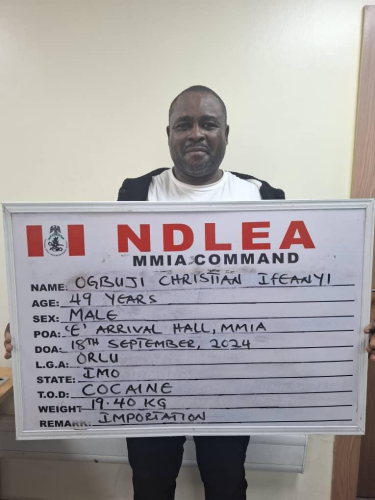
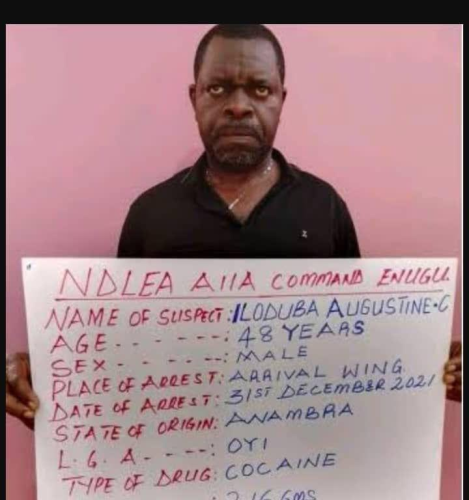
Four drug kingpins: Ogbuji Christian Ifeanyi; Iloduba Augustine Chinonye; Shuaibu Nuhu Isa (a.k.a Don) and Zidon Zurga have been convicted and sentenced to a total of 95 years in prison by the Federal High Court in Lagos and Yola, Adamawa state over trafficking of cocaine and skunk worth over N4.6 billion. Ogbuji was intercepted by operatives of the National Drug Law Enforcement Agency, NDLEA, at the Murtala Muhammed International Airport, MMIA Ikeja Lagos on Wednesday 18th September 2024 during an inward clearance of Ethiopian Airlines flight passengers from Addis Ababa to Lagos for importing 817 wraps of cocaine weighing 19.40 kilograms with an estimated street value of Four Billion Six Hundred and Fifty-Six Million Naira (N4,656,000,000.00).
That was barely 16 months after the 48-year-old businessman was arrested and convicted for ingesting 93 pellets of cocaine. He was first arrested at the Nnamdi Azikiwe International Airport, NAIA, Abuja, on Wednesday 10th May 2023 upon arrival from Uganda via Addis Ababa, onboard Ethiopian Airlines flight ET 951 for ingesting 93 pellets of cocaine with a gross weight of 1.986kg. He was subsequently arraigned before Federal High Court 12 Abuja presided over by Hon. Justice Mobolaji Olajuwon in charge no: FHC/ABJ/CR/192/2023 and convicted on 13th July 2023. Ogbuji was sentenced to two years imprisonment with an option of paying a fine of Three Million Naira (N3,000,000.00), which he paid and was set free.
Not done with crime, Ogbuji was again arrested at the Lagos airport with the large consignment of cocaine on 18th September 2024, after which he was arraigned before Justice Yellim Bogoro of the Federal High Court Lagos in charge number: FHC/L/845C on 16th January 2025. He was eventually sentenced on 28th February to five years imprisonment on count one with an option of seven million naira fine and 10 years imprisonment on count two without an option of fine. In the event that he failed to pay the N7million fine, the judge ruled that the convict will serve a total of 15 years in jail consecutively. The court ordered the forfeiture of monetary exhibits and other items found on him at the time of his arrest. In his own case, 51-year-old Iludoba was arrested by NDLEA operatives on new year eve, 31st December 2021 at the Akanu Ibiam International Airport, Enugu, for cocaine trafficking. He was found to have ingested 58 wraps of the illicit drug, 48 of which he excreted on transit in Addis Ababa, Ethiopia while he expelled the balance of 10 in NDLEA custody after his arrest on 1st January 2022. He was thereafter arraigned on two counts in charge number FHC/EN/CR/18/2022 before Justice Folashade Giwa Ogunbanjo of the Federal High Court, Enugu. After three years of diligent prosecution, Iludoba was convicted and sentenced to five years imprisonment on each count, bringing his total years in jail to 10 years, which will run concurrently from the date of his conviction, Wednesday 5th March 2025.
In the case of Shuaibu Nuhu Isa (a.k.a Don), 55, and Zidon Zurga, 50, they were arrested by NDLEA operatives on 25th November 2024 along Numan- Yola road with 500.800kg skunk, a strain of cannabis, concealed in a pilot Toyota Hilux vehicle marked Lagos NT 829 AAA and a Prado SUV with a fake presidency number plate 01B-266 FG. They were later arraigned before Justice Bala Usman in charge number: FHC/YL/150 /2024 and convicted on 7th February 2025 to 35 years imprisonment each on two counts, bringing the combined years in jail for both of them to 70 years or pay a fine of N25 million each. The court also ordered the interim forfeiture of the two jeeps used in trafficking the illicit drug consignment. Reacting to the conviction of the trio, Chairman/Chief Executive Officer of NDLEA, Brig Gen Mohamed Buba Marwa (Rtd) commended the trial courts, the teams of officers who investigated and prosecuted the three cases at the MMIA Strategic Command in Lagos, Akanu Ibiam International Airport Special Area Command, Enugu and the Adamawa State Command for their diligence and professionalism. He said “the conviction and the forfeiture of the convicts’ instruments of crime will further strengthen the deterrent effect of our ongoing effort to totally dismantle every drug network in the country.”