www.newstower.ng

Muhammad Ali visited Bob Marley on his deathbed — Bob’s final words to the champion changed everything.


Miami, Florida. Cedars of Lebanon Hospital. May 9, 1981. 4:47 pm. Muhammad Ali walked slowly down the hospital corridor, more slowly than he usually moved. At 39, the greatest boxer of all time was beginning to feel that something was wrong with his body. A tremor in his hands, a slowness in his movements, something he couldn’t fight with his fists


But today wasn’t about Ali’s fight. Today was about saying goodbye to a friend. Bob Marley was dying in room 318. Ali had received the call two days ago. Rita Marley’s voice, calm, breaking: “Muhammad, if you want to see Bob, you need to come now. The doctors say days, maybe hours.”


Ali had canceled everything. He flew to Miami immediately because Bob Marley wasn’t just another musician to Ali. Bob was a brother in the struggle. The door to room 318 was partially open. Ali knocked softly. Rita appeared. Her eyes were red from crying.


—Muhammad. Uh, thanks for coming.


Ali hugged her gently.


“How is he?”


“Awake, weak. He’s been asking for you.”


Ali entered the room. Bob Marley lay on the bed, his body reduced to barely 80 pounds. The dreadlocks that had been his crown now looked thin against the pillow. His skin had taken on a grayish pallor. But when Bob saw Ali, his eyes lit up. A smile crossed his face


—Champ— Bob whispered. —You came.


Ali walked over to the bed and sat in the chair beside it. She gently took Bob’s hand.


—Of course I came, brother. Do you think I’d miss saying goodbye to the man who taught me about true courage?


Bob’s smile grew slightly.


—I didn’t teach you anything. You are Muhammad Ali. The greatest.


“The greatest boxer, perhaps,” Ali said. “But you, you were the greatest warrior. You fought with music, you fought with words, you fought with your whole spirit, and you never backed down.”


Bob’s breathing was labored. Every word required effort.


—Neither did you, champ. You gave up everything. Your title, your freedom, your best years, because you wouldn’t fight in Vietnam. Because you stood up for what you believed in.


Ali nodded.


It took me three and a half years. They took away my belt, they took away my license, they took away my ability to earn money, but I couldn’t fight in a war I didn’t believe in. I couldn’t kill people who never called me the N-word


“I know,” Bob said. “That’s why you changed my life.”


Ali looked surprised.


“I changed your life, brother. You’re the one who changed the world. Your music reached billions. You took reggae to every country. You united people across every divide.”


Bob shook his head weakly.


“But I learned courage from you. 1967. I was 22. I saw you refuse to go to Vietnam. I saw them take your title away. I saw the whole world turn against you. And you stood there and said, ‘I have no quarrel with those Viet Cong.’ You were willing to go to prison for your beliefs.” Bob paused, gathering his strength. “That taught me something, champ. It taught me that true courage isn’t fighting when the crowd is behind you. It’s standing alone when everyone thinks you’re wrong. That’s what I tried to do with my music. Stand up for something even when it cost me.”


Ali felt tears welling up in his eyes.


—Bob, you did more than defend. You changed hearts. You made people think. You made them feel. That’s bigger than anything I did in a ring.


“No,” Bob said firmly, with more strength than he’d had in days. “What you did in that ring changed everything. You weren’t just boxing. You were showing Black people that we didn’t have to accept what the world said about us. You were beautiful. You were proud. You were unapologetically yourself. That gave the rest of us permission to be ourselves, too.”


Ali squeezed Bob’s hand gently.


—We were fighting the same fight, only in different arenas.


“The same fight,” Bob agreed. “Freedom, dignity, the right to be who we are without apologizing.”
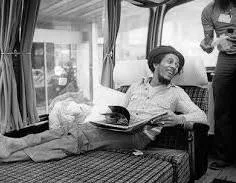


They sat in silence for a moment. Outside the window, Miami continued its noise. Cars, people, life moving on, while in this room time seemed suspended. Bob spoke again, his voice calmer now.


—Champ, can I tell you something?


—Anything, brother.


—I’m not afraid to die. I’ve made my peace with Jah. I’ve done what I came here to do, but I’m afraid of what I’m leaving behind


Ali leaned closer.


—What do you mean?


—I’m afraid people will remember the music but forget the message. I’m afraid they’ll dance to *One Love* but not live it. I’m afraid they’ll make me a legend and miss the point. —Bob’s eyes locked onto Ali’s—. Do you understand this? They made you a legend, too. Muhammad Ali, the greatest. But how many people remember why you were great? Not the boxing, the stance you took, the price you paid


Ali felt the weight of Bob’s words.


—You’re right. People remember the fights, the provocations, the spectacle, but they forget that I went to prison for my beliefs. They forget that I lost years I can never get back.


“Exactly,” Bob said. “So I need to ask you something, champ. When I’m gone, when they turn me into posters and T-shirts and nostalgia, will you tell them? Will you remind people what this was really about?”


Ali felt his throat close up.


—Tell them what, Bob?


Bob’s voice became urgent despite his weakness


“Tell them it cost something. Tell them courage always costs something. Tell them I didn’t die for the music. I died because I didn’t stop. I didn’t slow down. I didn’t compromise the message for my health. Tell them that’s what real commitment looks like.” Bob paused, breathing heavily. “Tell them about 1976. About the assassination attempt. About seven gunmen breaking into my house two days before the Smile Jamaica concert. About bullets hitting me, hitting Rita, hitting my manager. About how we still did that concert 48 hours later, performed for 80,000 people with bullets still in my body.”


Ali had heard the story, but never directly from Bob.


—Why did you do it? Why risk your life for a concert?


“Because the message was bigger than my life,” Bob said simply. “Because if I let fear stop me, then violence wins. Division wins, hate wins. I had to show that love is stronger than bullets, that music is more powerful than guns.” Bob looked intently at Ali. “Just like you showed the world that principles are more powerful than punishment. You could have gone to Vietnam. You could have kept your title, your money, your fame. But you chose principles over comfort. That’s what changed my life, champ. That’s what I tried to live by.”


Ali dried his eyes.


—Bob, you handled it better than I did. You never stopped, even when I was killing you.


“And that’s my regret,” Bob said quietly. “I should have stopped. I should have rested. I should have spent more time with my children, with Rita, with my mother. I thought the mission was more important than my life. But now, dying at 36, I realize the mission needed me to live. I could have done more if I had taken better care of myself.”


Ali felt something break inside him. Bob was telling him something important, something Ali needed to hear.


—Bob, are you telling me to slow down, to take care of myself?


Bob nodded weakly.


“Champ, I can sense something’s wrong with you. I see it in your movements. You’re fighting something.”


Ali’s hands trembled slightly. He’d been noticing it for months. The trembling, the slowness. He hadn’t told anyone yet.


—I don’t know what it is, but yes, something is wrong.


“Then learn from my mistake,” Bob said urgently. “Don’t sacrifice your life for your legacy. Take care of yourself. Rest. Allow yourself to be human. The world needs Muhammad Ali alive more than it needs another fight, another show, another performance.” Bob’s breathing became more labored. “Promise me, champ. Promise me you’ll take care of yourself. Promise me you’ll live because your children need you. Your wife needs you. The world needs you. And you can’t help anyone if you’re dead.”


Ali felt tears running down his face.


—I promise, Bob. I promise.


Bob smiled. Then he said something that would echo in Ali’s mind for the rest of his life.


—You taught me how to stand up. Now I’m teaching you how to rest. Both are courage, champ. Both matter.


Those words hung in the air between them. Two warriors. Two men who had given everything for their beliefs. One dying too young. One fighting to live longer. Bob’s voice grew even calmer.


—Muhammad, I need you to know something else.


—What, brother?


—Meeting you changed how I saw myself. You were a Black man who refused to be anything but proud, refused to be silent, refused to back down. You made me believe I could do the same with music. You made me believe one person standing up for the truth could change the world. —Bob paused— So everything I did, every song I wrote, every stage I stood on, that was partly because I saw you stand in that courtroom in 1967 and refuse to go to war. You inspired millions, champ, including me. And I just needed you to know that before I went


Ali completely collapsed. This man, this warrior, this voice of a generation was using his last breaths to thank Ali for the inspiration.


—Bob, I don’t know what to say.


—Don’t say anything. Just remember that when they ask you about Muhammad Ali, tell them about the cost. Tell them about the years you lost. Tell them it was worth it because you stayed true to yourself. And when they ask you about Bob Marley, tell them the same thing. Tell them I paid the price for the message and I would do it again.


Ali held Bob’s hand tighter.


—I’ll tell him, brother. I promise I’ll tell him.


They sat together for another hour, talking less, simply being present. Two champions who had fought different fights but bore the same scars. Finally, Bob grew too tired to stay awake. Ali got up to leave.


—Champ—Bob whispered, his eyes closed. —One more thing.


—Yes, Bob.


—It floats like a butterfly, stings like a bee, but also rests like a human. Promise?


Ali smiled through his tears.


—I promise.


Bob Marley died two days later, on May 11, 1981, at 11:45 a.m. He was 36 years old. Ali attended the memorial service in New York. He was asked to speak


“Bob Marley taught me something in our last conversation that I’ll carry with me for the rest of my life,” Ali told the crowd. “He taught me that courage has two forms: standing up when everyone tells you to sit down and resting when everyone tells you to act. Bob stood up his whole life. He stood up for justice, unity, love. And he paid the ultimate price. He worked himself to death for his message. That’s heroic. That’s dedication. But it’s also a warning. Don’t sacrifice your life for your legacy. Don’t give everything until there’s nothing left. Bob told me, ‘Take care of yourself. Rest. Live. Because the world needs you alive.’”


Ali paused, his voice breaking.


—Bob Marley changed my life twice. Once in 1967 when he saw me refuse to go to Vietnam and learned that courage means being alone. And once in 1981 when he was dying and taught me that courage also means knowing when to rest. Both lessons saved me. One gave me purpose. The other could buy me years.


For the next 15 years, as Muhammad Ali battled Parkinson’s disease, he often thought of that hospital room, of Bob’s trembling hand in his, of Bob’s final wisdom. Ali slowed down, stopped accepting every fight, every appearance, every demand. He rested. He spent time with his family. He took care of himself. And he outlived Bob by 35 years.


In 2016, when Muhammad Ali died at the age of 74, his daughter Laila spoke at his funeral.


“My father often spoke of Bob Marley, of their last conversation, of how Bob, as he was dying, told my father to live, to rest, to take care of himself. My father said that Bob gave him permission to be human, to stop performing and start living. That gift gave us decades more with him. He gave the world decades more of his wisdom, his presence, his love.” Laila continued, “Two warriors, two champions, two men who stood up when the world told them to bow. But in the end, Bob taught my father that the greatest fight isn’t always the one in the ring or on the stage. Sometimes the greatest fight is staying alive for the people who love you.”


Today at the Muhammad Ali Center in Louisville, there’s a small exhibit about Ali’s friendship with Bob Marley. It includes a photo of them together from 1978. Two icons, two fighters, two men who changed the world. Below the photo is a quote from Ali’s last interview about Bob.


Bob Marley told me, “You taught me how to stand up. Now I’m teaching you how to rest. Both are courage.” Those words saved my life. I stood up for justice, but I also rested for my family. Both mattered. Bob died at 36 because he never stopped. I lived to 74 because he taught me that it’s okay to stop. That’s the gift he gave me, and I’m grateful every day.


Legacy isn’t just music or fights. Legacy is the wisdom passed down between warriors. The understanding that courage takes many forms. The knowledge that standing up for something is important, but living for someone is essential. Bob Marley stood until he was killed. Muhammad Ali learned to rest before he was killed. Both were heroes. Both were champions. But only one lived long enough to tell the tale.


If you’re reading this and you’re consumed by a cause, a career, a mission, listen to Bob Marley’s last words to Muhammad Ali. You can’t help anyone if you’re dead. Take care of yourself. Rest. Live. Stand up for what matters, but also rest for those who matter. Both are courageous. Both are necessary. Bob Marley taught Muhammad Ali that lesson with his last breath. And, Ali lived an extra 35 years because he listened.
Shakara Trybe Founder to unveil Nigeria’s first 30-foot Christmas tree made entirely from Nigerian fabrics this Detty December

By Ebinum Samuel


This Detty December, Lagos will witness a cultural milestone, the unveiling of the first-ever 30-foot Christmas tree made entirely from Nigerian fabrics, a groundbreaking installation designed to celebrate sustainability, unity, fashion, and community spirit happening on Christmas Eve, the 24th December at the J. Randle Centre for Yoruba Culture and History, Onikan Lagos Island.

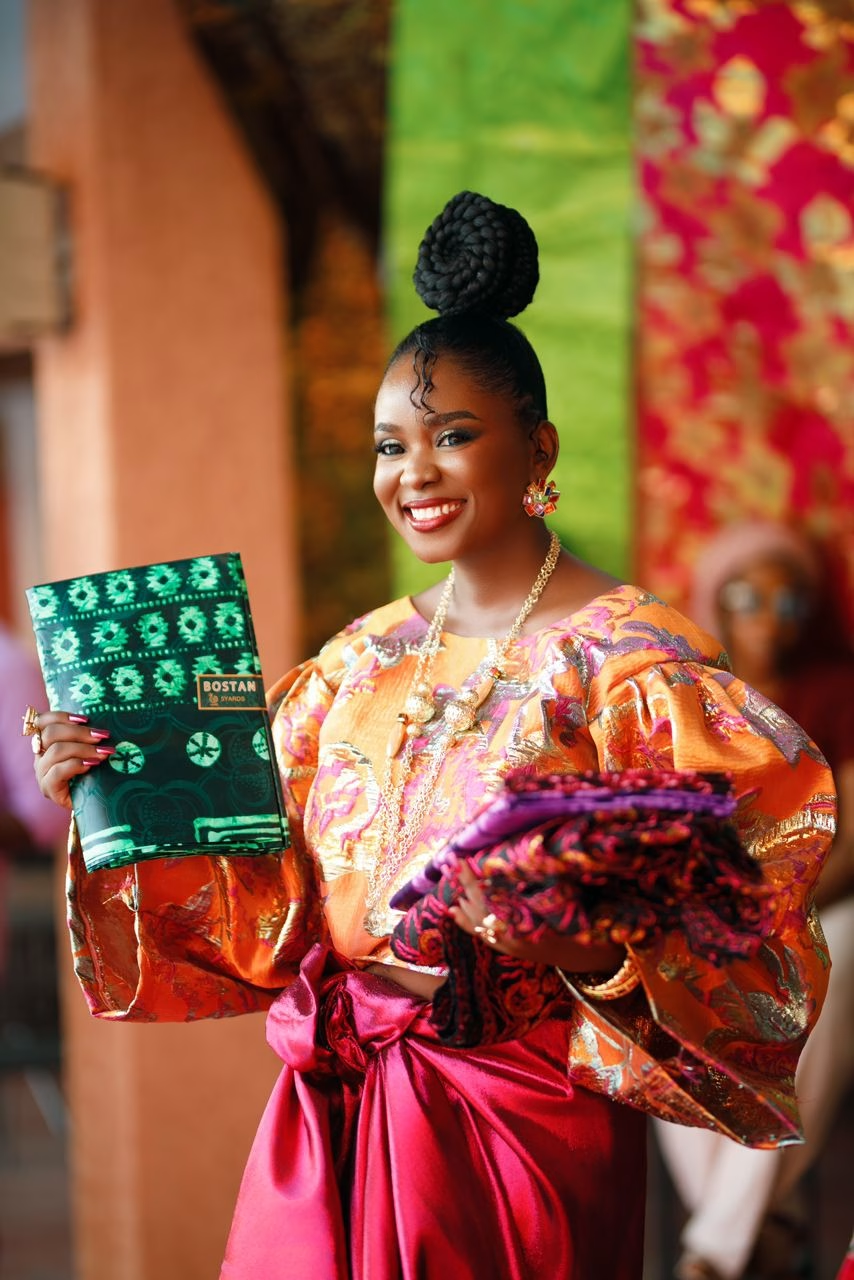
Spearheaded by Culture Influencer, Media Personality and Fashion Entrepreneur, Ebunoluwa “ebbiekikz” Dosumu, the founder of Trybe, the tree is made from hundreds of donated fabrics Aso-oke, Ankara, Adire, George, lace and more crowd sourced from families across the country each piece carrying its own memory, its own tribe, and making it a community project at its core.

Together, they form a towering masterpiece that reinforce a simple truth: fashion is one of the strongest threads that bind Nigerians together.

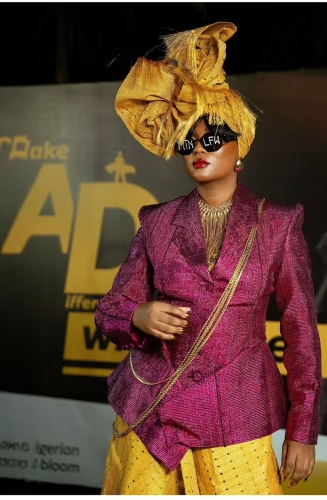
Attendees of A Shakara Christmas will be immersed in a day designed to spotlight the richness, beauty, and diversity of Nigerian culture. Highlights include an Interactive Stage Play, described as the first of its kind in Lagos, and a Cultural Fashion Runway by Shakara Trybe, a runway showcase featuring original Nigerian cultural pieces.

There will also be nostalgic experiences and festive characters, including throwbacks to the joys of growing up in Nigeria, traditional games, festive icons, and elements that evoke deep cultural nostalgia.


The event will further offer an Indigenous Food Tasting Experience, a curated tasting session of Nigerian dishes across tribes celebrating the nation’s culinary diversity and the flavours that connect communities.

Cultural spotlights and immersive installations will also be featured, with creative displays capturing the stories, traditions, and artistry that define Nigeria’s cultural landscape.

The night will close with a heartwarming moment led by Loud Urban choir in a communal carol session beneath the illuminated 30-foot fabric tree symbolizing togetherness, hope, and the spirit of a united Nigeria.

A Shakara Christmas marks the beginning of Ariya Village, a vibrant 13-day cultural festival dedicated to showcasing tradition, fashion, food, storytelling, community living, indigenous craftsmanship, and Nigerian creativity.

A Shakara Christmas is designed for Nigerians at home and abroad seeking meaningful, family-friendly, culturally rooted Detty December experiences.

For Nigerians and the diaspora searching for Detty December events in Lagos, family-friendly Christmas activities, cultural festivals in Nigeria, Nigerian Christmas experiences, sustainable fashion installations, heritage-driven creative events, end-of-year Lagos celebrations, and diaspora-friendly Nigerian cultural events.

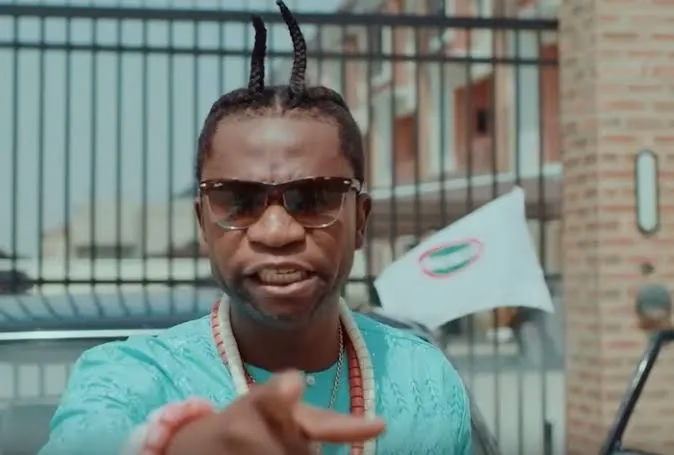
NAPTIP places Speed Darlington on watchlist


The National Agency for the Prohibition of Trafficking in Persons (NAPTIP) has placed Nigerian rapper Darlington Okoye, popularly known as Speed Darlington, on its watchlist after he reportedly failed to honour an invitation to the agency’s headquarters in Abuja.

The development was announced by NAPTIP’s Director of Legal and Prosecution, Ijeoma Mary Amugo, during a press briefing on Monday to kick off the 2025 edition of the 16 Days of Activism Against Gender-Based Violence.

According to Amugo, the agency had invited the musician to answer questions regarding a disturbing claim he made during a live Instagram session in May. In the viral broadcast, Speed Darlington allegedly boasted about having sexual relations with a 15-year-old girl—an act that amounts to sexual involvement with a minor and falls under NAPTIP’s mandate to investigate.

Fielding questions from journalists, the NAPTIP’s Director of Prosecution said the rapper tried to intimidate the agency.

NAPTIP further said it has not been able to trace Speed Darlington to a known address, making it difficult to get him to answer for the alleged crime.

“So what he did was to preemptively try to intimidate us by going to the social media to say that he wouldn’t come and that he wouldn’t respond to us, that we are kind of sitting on his human rights.

“So we tried our best to physically locate him because you have to locate the suspect before justice will be served,” Amugo stated.

She said, “So, as I’m speaking to you, the last report we have is that he’s outside the country and we have not heard from him yet. We have placed him on watch list. Anytime he enters Nigeria, NAPTIP is going to continue the investigation from where we stopped. So that is the status of the case for now.”

Director-General of NAPTIP, Binta Adamu Bello said the agency would be fine-tuning its implementation strategies to tighten the noose on offenders.

“Nigeria is making efforts to deal with the rising cases of human trafficking across the country.

“However, enforcement remains a challenge, given societal attitudes and cultural norms,” he said.

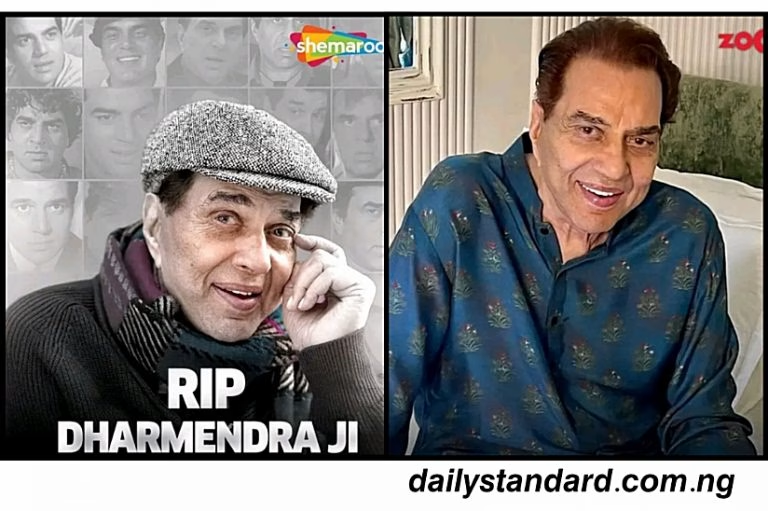
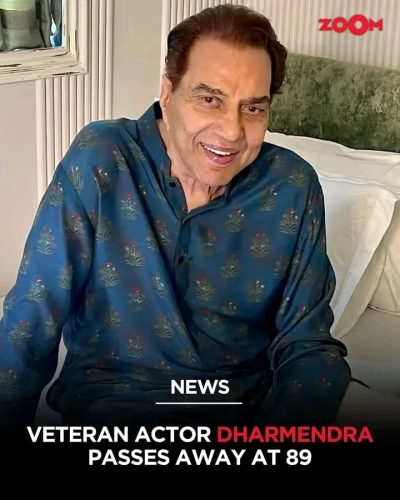
JUST IN: Dharmendra, iconic Bollywood actor and Indian cinema’s ‘He-Man,’ dies at 89


Often called Bollywood’s “He-Man,” he was known as one of the country’s most popular movie stars.


Dharmendra, one of Indian cinema’s most popular stars, whose versatile performances made him a defining screen presence of 1970s and 1980s Bollywood films, died Monday. He was 89.


The actor, who would have turned 90 on December 8, had been in and out of a hospital in the financial capital, Mumbai, over the past few weeks.


A senior police official who had spoken to Dharmendra’s doctor confirmed the death on condition of anonymity.


Prime Minister Narendra Modi offered his condolences, saying the actor’s death marks the end of an era in Indian cinema.


“He was an iconic film personality, a phenomenal actor who brought charm and depth to every role he played. The manner in which he played diverse roles struck a chord with countless people,” Modi said on social media platform X.


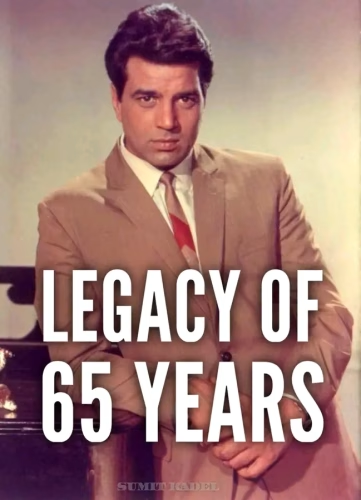
In a career spanning over six decades, he acted in more than 300 films


Often called Bollywood’s “He-Man,” Dharmendra combined the old-school heroism of an action star with the tenderness of a romantic lead, making him one of India’s most iconic actors.


In a career spanning over six decades, he acted in more than 300 films

Though most of his fame came from roles in which he embodied the archetype of a larger-than-life hero — upright, patriotic and fearless — his charming performances in romantic hits equally made him popular with the masses.


Dharmendra’s performance in “Sholay” (1975) — Bollywood’s take on the Spaghetti Western and regarded as one of India’s greatest films — earned him enduring popularity.


His roles in other Hindi-language hits, from the romantic comedy “Chupke Chupke” (1975) to the action drama “Mera Gaon Mera Desh” (1971), made him one of the most recognizable film faces from that era.


His role in Bollywood classic “Sholay,” where he played an affable character alongside Amitabh Bachchan, his co-actor in the film, cemented his status as a superstar. The duo’s on-screen partnership also became one of Bollywood’s most iconic pairings.


His on-screen chemistry with actress Hema Malini, whom he later married, became one of Bollywood’s most popular collaborations, as the pair acted together in more than two dozen films.


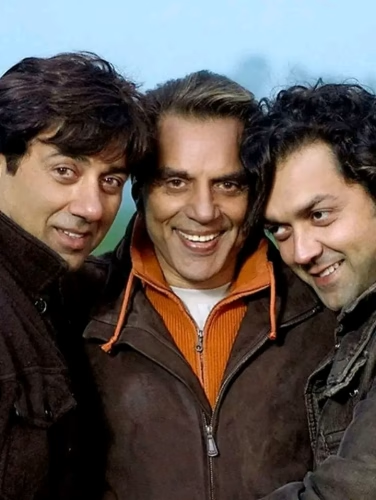
But their union was rooted in scandal. Dharmendra had married Prakash Kaur before his film debut, and went on to have four children with her, including two who would follow in his acting footsteps — Sunny Deol and Bobby Deol.


Despite his marriage to Malini in 1980, he reportedly never divorced Kaur and continued to live with her.


He embodied the archetype of a larger-than-life hero.

According to local media reports, he briefly converted to Islam before marrying Malini as Indian law disallows Hindus to marry twice, especially if their spouse is alive.


Dharmendra and Malini had two daughters, including Bollywood actor Esha Deol. His nephew, Abhay Deol, also joined the industry.


Later in his career, Dharmendra moved to more character-driven roles, frequently portraying paternal figures in the 1990s and 2000s in a career that continued through 2025. He was last seen in war biopic film “Ikkis.”


“I never thought I would come this far,” he said in a 2021 interview with Indian news website Rediff.


Dharmendra would have turned 90 on December 8

Born Dharmendra Kewal Krishan Deol in India’s northern state of Punjab in 1935, he grew up in a farming family and moved to Mumbai in the late 1950s, making his Bollywood debut in 1960.


Over a career spanning six decades, he acted in more than 300 films.


In 2012, Dharmendra was awarded the Padma Bhushan, India’s third-highest civilian honor, in recognition of his contribution to Indian cinema.


Dharmendra would have turned 90 on December 8


He also briefly turned to politics, serving as a Bharatiya Janata Party lawmaker in Parliament from 2004 to 2009, though his political stint was short-lived.


Dharmendra is survived by his wives, children and grandchildren.


Report Courtesy: Associated Press

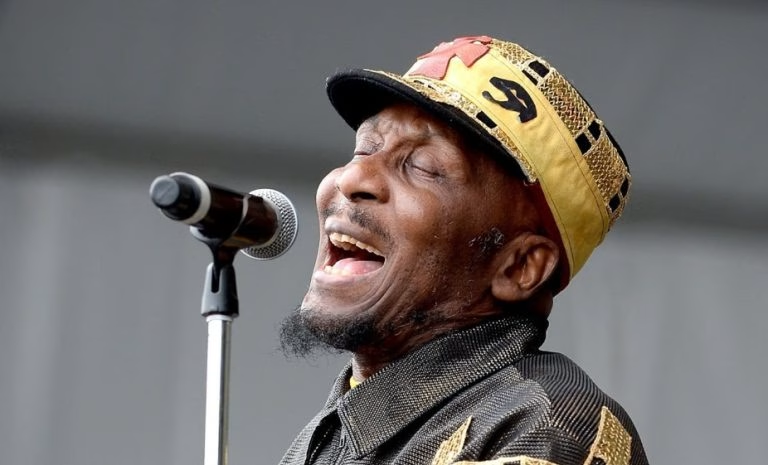
BREAKING: Reggae icon, Jimmy Cliff dies at 81


By Kehinde Okeowo


Jamaican reggae and soul musician, multi-instrumentalist, singer, and actor, James Chambers, popularly known as Jimmy Cliff, has passed away at the age of 81.


The family of the legendary musician announced his death on Monday on his official social media page.


His wife, LaTifa Chambers, wrote on Instagram: “It’s with profound sadness that I share that my husband, Jimmy Cliff, has crossed over due to a seizure followed by pneumonia.


”I am thankful for his family, friends, fellow artists and coworkers who have shared his journey with him.


”To all his fans around the world, please know that your support was his strength throughout his whole career. He really appreciated each and every fan for their love.”


ALSO READ: Katsina woman allegedly stabbed husband to death three days after wedding


Jimmy Cliff was best known for songs including “Many Rivers to Cross” and “The Harder They Come,” the title song for the movie of the same name from 1972, which also featured him.


The film’s soundtrack was a major international success and did much to spread the appeal of Jamaican reggae.


Born in Jamaica in 1944, Cliff scored his first local hit aged just 14 with “Hurricane Hattie” and would go on to win two Grammy awards and pick up seven nominations.


He was only one of two Jamaicans to be inducted into the Rock & Roll Hall of Fame, alongside Bob Marley.

Christian families, churches under attack in Nigeria because of their faith, says Nicki Minaj


Popular American rapper Onika Tanya Maraj-Petty, widely known as Nicki Minaj, has spoken out about the rising attacks on Christians in Nigeria.

The award‑winning rapper said Christians in the country are being “targeted and killed en masse,” urging the international community to take swift action to confront extremism and protect churchgoers across the West African nation.

“Christians are being targeted, driven from their homes, and killed. Churches have been burned, families have been torn apart, and entire communities live in fear constantly simply because of how they pray,” the ‘Pink Friday’ rapper said during a speech at the United Nations on Tuesday.

Nicki Minaj’s speech followed an official invitation from the White House to address a UN conference and experts on the alleged ongoing violence against Christians in Nigeria after she came out in support of the decision by President Donald Trump to redesignate Nigeria as a Country of Particular Concern.

During her remarks, the 42-year-old thanked Mr Trump for the steps he has taken so far to put a global spotlight on the situation of Nigerian Christians, noting that freedom of religion and belief should be natural rights.

“I would like to thank President Trump for prioritising this issue and his leadership on the global stage in calling for urgent action to defend Christians in Nigeria and to combat extremism and to bring a stop to violence against those who simply want to express their natural right to freedom of religion or belief,” Nicki Minaj said.

She added, “Music has taken me around the globe. I have seen how people, no matter their language, culture or religion, come alive when they hear a song that touches their soul. Religious freedom means we all can sing our faith regardless of who we are, where we live, and what we believe. But today, faith is under attack in way too many places.”

Speaking further, Nicki Minaj stressed that her decision to champion the situation in Nigeria was not to divide or take sides after receiving criticism over her position, noting that “It is about what I have always stood for my entire career, and I will continue to stand for that for the rest of my life”.

Quit illicit drug trade now or get ready for more hard time, Marwa warns barons, cartels


By Ebinum Samuel


Thanks President Tinubu for his reappointment to continue ongoing efforts against drug menace


Chairman/Chief Executive Officer of the National Drug Law Enforcement Agency (NDLEA) Brig Gen Mohamed Buba Marwa (rtd) has warned drug barons, traffickers and their cartels to quit the criminal trade or face more hard time during his second tenure.

Marwa who was reappointed by President Bola Ahmed Tinubu for a second tenure of five years on Friday 14th November 2025 told jubilating management staff, officers, men and women of the Agency who gathered to welcome him at its National Headquarters in Abuja following the presidential announcement that his second tenure will be hell and bleak for those who fail to quit the illicit drug trade. He expressed appreciation to the president for the recognition of ongoing efforts against substance abuse and illicit drug trafficking in the country.


“First of all, what a surprise, I did not expect to come back from jumat service to meet these great felicitations, dancing and singing by our personnel. Thank you very much. We would like to thank the almighty God, because always the glory has to go to Him for everything. We thank the President and Commander-in-Chief for the special recognition of our collective efforts and the new mandate for us to continue with the war against drug abuse and trafficking. I thank the management, officers, men and women of the agency, who continue to provide service to the nation 24/7, in spite of the risks that you all face”, he stated.

He also acknowledged the unflinching support by the Hon. Attorney General of the Federation and Minister of Justice, Prince Lateef Fagbemi, SAN and the Minister of Finance, Mr. Wale Edun while also expressing thanks to “all our local and international partners, with whom we have continued to collaborate towards ridding Nigeria of illicit substances.”

For the drug cartels, Marwa has a message: “First, this word must go to the cartels. The cartels have not seen anything yet. I promise them this second tenure is going to be hell and bleak for them. Drugs shall not pass, in or out or within Nigeria.” He reaffirmed the Agency’s commitment towards President Tinubu’s mandate, assuring that “in line with our Act, we will continue to do our level best. I remember in my inaugural speech, the day I took over, and I said very clearly that NDLEA will be feared by the drug cartels. And that’s just the beginning.”

“At the same time, I must appeal to those who are engaged in illicit drug trafficking that this is the right time for them to drop that criminal business and face something legitimate. It is in line with that that we established the Alternative Development Unit, which seeks to persuade those who are perpetrating the illicit drug activities, particularly cannabis growers, who are our greatest challenge in Nigeria, to desist from the habit, collaborate with us. We are going to support towards licit cultivation of crops that are legitimate, legal, and you can sleep with your two eyes closed.


“But those who refuse to do that can be sure that the NDLEA is up and able on its task of law enforcement. You will be arrested, the drugs will be seized, and your assets will be confiscated. So, you come out from jail, there will be nothing left.”

He also assured that the Agency will remain committed to its drug demand reduction efforts. “I’ll take the opportunity again to announce the rededication of our efforts towards prevention, sensitization, counseling, treatment, and rehabilitation of our children in our 30 rehabilitation centres. And with the support of the President and the Renewed Hope Agenda, seven more rehab centres are coming up under the 2025 budget that will now make every state to have its own rehab centre.

“And as well, there will be zonal rehab, more rehab centres and we are getting full collaboration from the Honorable Minister of Health. We appreciate his efforts also, and the Honorable Minister of Education, who has accepted our recommendation for drug tests for our children on admission to tertiary institutions, so that with this we can catch them young before it gets into addiction stage. May the Almighty God bless our President, bless all those that are supporting us, bless the officers, men and women of NDLEA.”

Two Japanese Boxers Fighting On Same Card Die From Brain Injuries After Aug. 2nd Fights

  Two Japanese boxers have died from brain injuries suffered during separate fights at an Aug. 2 match in Tokyo, according to world boxing governing bodies.   Shigetoshi Kotari’s death was announced by the World Boxing Council and World Boxing Organization on Aug. 8. The death of Hiromasa Urakawa was announced by the WBO on Aug. 9.   Kotari, 28, had lost consciousness, according to the WBC, after a 12-round match, a draw, against Yamato Hata for Hata’s Oriental and Pacific Boxing Federation super featherweight title. Kotari was taken to the hospital and received emergency brain surgery for a subdural hematoma.   A subdural hematoma is a type of bleeding near the brain that can happen after a head injury, according to the Cleveland Clinic.   “Deeply sorry for this loss a ring accident which makes all of us go back to continue research to find ways to make boxing safer and implement prevention programs,” Mauricio Sulaimán, the WBC’s president, posted on social media. “Our deepest sympathy and condolences for his family and the boxing community in Japan.”   Urakawa, 28, also needed brain surgery, a craniotomy, after a six-round loss to Yoji Saito at the same event, the BBC reported, citing the Japan Boxing Commission.   “We extend our deepest condolences to the families, friends, and the Japanese boxing community during this incredibly difficult time,” the WBO posted.   The commission has since lowered OPBF title bouts from 12 rounds to 10.   USA TODAY

Why I’m still single at 52 — Nollywood actress, Bimbo Akintola

Nollywood veteran, Bimbo Akintola, has spoken candidly about her personal life, admitting she is unmarried and has no children at the age of 52.


In a recent chat with Pulse Nigeria, when asked whether she had kids, the actress replied, “No, I don’t unfortunately.” She also confirmed, “I’m 52 years old. Born 1973, May 5th.”


On the subject of her relationship status, Akintola made it clear that her being single was not deliberate. “Not chosen oo,” she stated.


Since making her screen debut in 1995 in Owo Blow alongside Femi Adebayo, Akintola has become one of the most recognisable faces in Nigerian cinema. She went on to feature in Out of Bounds (1997) with Richard Mofe Damijo, cementing her place in the industry.

Born in Lagos, she attended Maryland Convent Private School and Command Day Secondary School before earning a degree in Theatre Arts from the University of Ibadan.


Most recently, Akintola portrayed Inspector Mo Ogunlesi in Kemi Adetiba’s series To Kill a Monkey.

‘I Might Want More Kids Later’ – Tiwa Savage Explains Why She Froze Her Eggs


Nigerian Afrobeats star Tiwa Savage has revealed that she froze her eggs as a precaution in case she decides to have more children in the future.


Speaking in a candid interview with Zeze Mills, the 42-year-old mother of one said she wished she had taken the step earlier, urging women in their 30s to consider egg freezing as a way of taking control of their fertility.


“Having my first child in my 30s was beautiful because I was more financially and emotionally stable,” she said. “One advice I will give to women in their 30s is – whether you want children or not, freeze your eggs. I wish I did it earlier. But I’ve done it now. I don’t know if I want more kids, but in case I do, I have that insurance.”


Savage explained that women are born with a limited number of eggs, and reserves could decline unexpectedly. “You could wake up at 36 and your egg reserve is gone, and that’s when you now decide you want to have kids. So, I’m really a big advocate for egg freezing now,” she added.


Tiwa Savage welcomed her first child, Jamil, on July 22, 2015, at the age of 34 with her then-husband, Teebillz.