www.newstower.ng

Reclaiming the Spirit of Public Service: The POHAN Example


By: Rademene Asonye

In a nation where cynicism toward public office has hardened into habit, the emergence of the Public Office Holders Association of Nigeria (POHAN) offers a welcome ray of hope — a reminder that public service, when rightly understood, remains the highest form of patriotism.

Founded in February 2020 by Bashorun MD Eseyin, POHAN was conceived as the umbrella organization for all public office holders across Nigeria. In just five years, the Association has grown into a credible and reform-minded body, promoting integrity, patriotism, and efficiency in the Nigerian public sector. Its founding vision is bold: to rebuild a public service anchored on ethical values, professionalism, and an unwavering commitment to the common good.

A Vision Rooted in Patriotism

The idea behind POHAN is not bureaucratic convenience but moral necessity. For decades, Nigeria’s public institutions have suffered from a deficit of trust. The civil service, once the pride of the nation, has in many respects become synonymous with inefficiency and neglect. Against this backdrop, Bashorun Eseyin’s initiative stands out as a deliberate effort to restore dignity and discipline to governance.

Eseyin, who serves as the founding President, envisioned POHAN as both a unifying and reformative platform — one that brings together office holders from all tiers of government under a shared ethos of service. His mission is clear: to rekindle the flame of patriotism in those who carry the burden of public responsibility and to remind them that leadership, at its core, is stewardship.

Partnerships that Empower and Reform

POHAN’s growing influence can be measured not only by its vision but by its partnerships. In collaboration with the Office of the Secretary to the Government of the Federation (OSGF), the Association has organized capacity-building and ethical reorientation programs designed to instill patriotism and efficiency in public servants.

Similarly, its partnership with the Association of Local Governments of Nigeria (ALGON) reflects a recognition that reform must begin at the grassroots. By promoting ethical standards and accountability among local government leaders, POHAN is ensuring that good governance is not confined to the corridors of Abuja but reaches the communities where citizens live and work.

Through these alliances, POHAN has demonstrated that systemic change is achievable when institutions cooperate on shared values rather than political convenience.

A Platform of Credibility and Influence

POHAN’s activities have continued to attract an impressive array of national and international dignitaries. From Senator George Akume, Nigeria’s Secretary to the Government of the Federation, to global figures such as Sir Clyde Rivers and leadership advocate Dr. Sam Adeyemi, POHAN’s programs have drawn attention from leaders across sectors.

Federal Ministers, Governors, Senators, and Members of the House of Representatives have all participated in its events, lending both political and moral validation to its mission. This diversity of support speaks to a growing consensus that Nigeria’s governance challenges cannot be solved by legislation alone — they require a moral and institutional renewal within the public service itself.

Institutionalizing Integrity through Public Service Day

In furtherance of its reform agenda, POHAN has resolved to commemorate the United Nations Public Service Day annually — a symbolic but significant commitment. This global observance, which celebrates the value and virtue of public service, aligns perfectly with POHAN’s goal of recognizing and rewarding excellence in governance.

By observing this day, POHAN is institutionalizing a culture of reflection and accountability — reminding office holders that their ultimate measure is not tenure or title, but impact and integrity.

The Case for National Support

POHAN’s progress so far is commendable, but its success should not be left to the vision of a few. Reforming the Nigerian public service requires collective will — from policymakers, institutions, and the citizenry alike. Ministries, departments, and agencies must align with POHAN’s training and ethical programs, while civil society organizations and citizens must engage constructively in holding public officials accountable.

Public trust is not rebuilt overnight; it is earned through consistent, transparent, and selfless service. POHAN is laying the foundation for that transformation, but its work must be sustained through national support and institutional collaboration.

A Model for Ethical Leadership

In a country often accused of lacking role models in governance, POHAN is quietly producing them. Its emphasis on continuous learning, ethical reform, and patriotic leadership provides a replicable model for other professional associations. Bashorun Eseyin’s brand of leadership — disciplined, visionary, and inclusive — reminds Nigeria that transformation does not begin with policy pronouncements but with personal conviction and institutional courage.

Restoring Dignity to Public Office

The true test of governance is not in grand rhetoric but in service that transforms lives. By promoting accountability, ethical conduct, and professionalism, POHAN is helping to redefine what it means to hold public office in Nigeria.

Its message is as clear as it is urgent: public service must once again become a noble calling — one rooted in sacrifice, patriotism, and genuine concern for the people.

Nigeria’s journey toward reform may be long, but with institutions like POHAN leading the charge, there is hope that the public sector can regain its lost integrity and purpose. Bashorun MD Eseyin and his team deserve commendation for daring to believe that a public service that works for all Nigerians is not a dream — it is a duty.

Dr. Rademene Asonye, MNIPR
President, Female Journalist Network, Nigeria
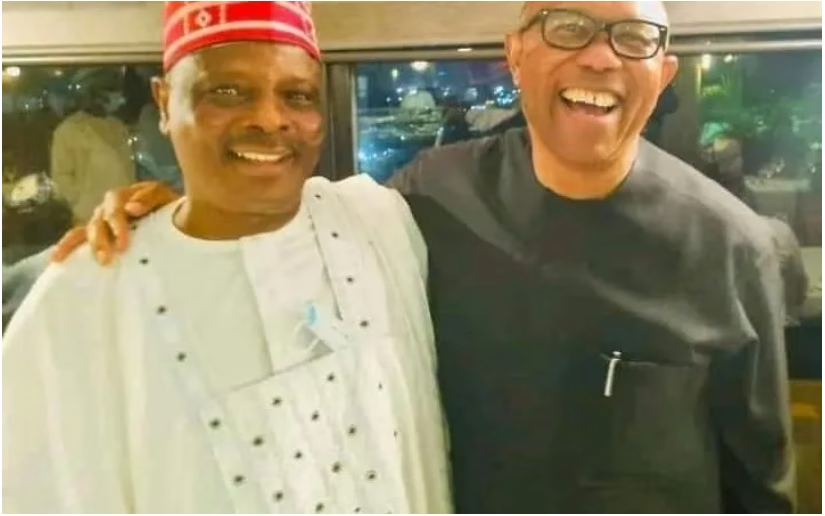
2027 : We are ready to work with Peter Obi, others if….

Former Kano State governor and 2023 presidential flag bearer of the New Nigeria People’s Party (NNPP), Rabi’u Kwankwaso, says the 2027 general elections will be highly competitive, adding that his party is open to collaborations with key political figures, including President Bola Tinubu and Labour Party’s Peter Obi.

Speaking in an interview with BBC Hausa, Kwankwaso, who recently turned 69, said the NNPP is willing to align with any political group or leader that shares its commitment to improving the welfare of ordinary Nigerians.

“If you are asking us to join APC, you must tell us what NNPP will gain. We have gubernatorial candidates in all the states and full structures nationwide. What will you offer them if we join?” Kwankwaso said while hosting Buhari Bakwana, a former political adviser to ex-Governor Abdullahi Ganduje, along with APC members from all 44 local government areas of Kano State, at his residence on Miller Road.

Kwankwaso had earlier, in September, hinted that the NNPP could consider an alliance with the ruling All Progressives Congress (APC), provided such a move would offer clear advantages to his party.

President Tinubu, who is said to have held a series of discussions with the opposition leader in recent years, has previously referred to Kwankwaso as a “friend within the progressive fold.”

Reaffirming his openness to political partnerships, Kwankwaso told the BBC that any cooperation would depend on shared values and integrity.

He said, “We’re ready for anyone, whether it is the APC, PDP, ADC, Jonathan, or Peter Obi. If we are satisfied with their competence, we will join forces to achieve success. What we are looking for are competent leaders with integrity. The key thing is that whoever we ally with, be it the APC or another party, must be committed to the needs of Nigerians. If they fail to meet our expectations, we would not continue with them.

“What we are asking for is that the common people should benefit, that the masses should be free, the youth educated and security improved. Our people are being killed in Sokoto, Kebbi, Zamfara, parts of Kaduna, and other states. The victims are ordinary citizens, because the elites have fled to Abuja, where they are living in luxury. Some of them, like members of the House of Representatives, senators and ministers, have no concern other than enriching themselves, buying big houses, and flaunting expensive cars. They are appointed to positions and act as if they are untouchable, but I am confident that Allah will judge them accordingly.”

The NNPP leader predicted that voter awareness and participation will make the 2027 elections tougher than previous ones.

“I believe the 2027 elections will be much tougher. Unlike before, people are now more involved and more concerned. Everyone is looking for a way out because of the country’s situation. Thanks to radio and social media, the masses are now informed. Everyone is trying to secure a better future for themselves, their families and their loved ones.

“This time, nobody would come on election day asking for money to cast their votes. You may probably see new things unfold; things that have never happened before in Nigeria’s electoral history.”

Davido holds talks with French President, Emmanuel Macron


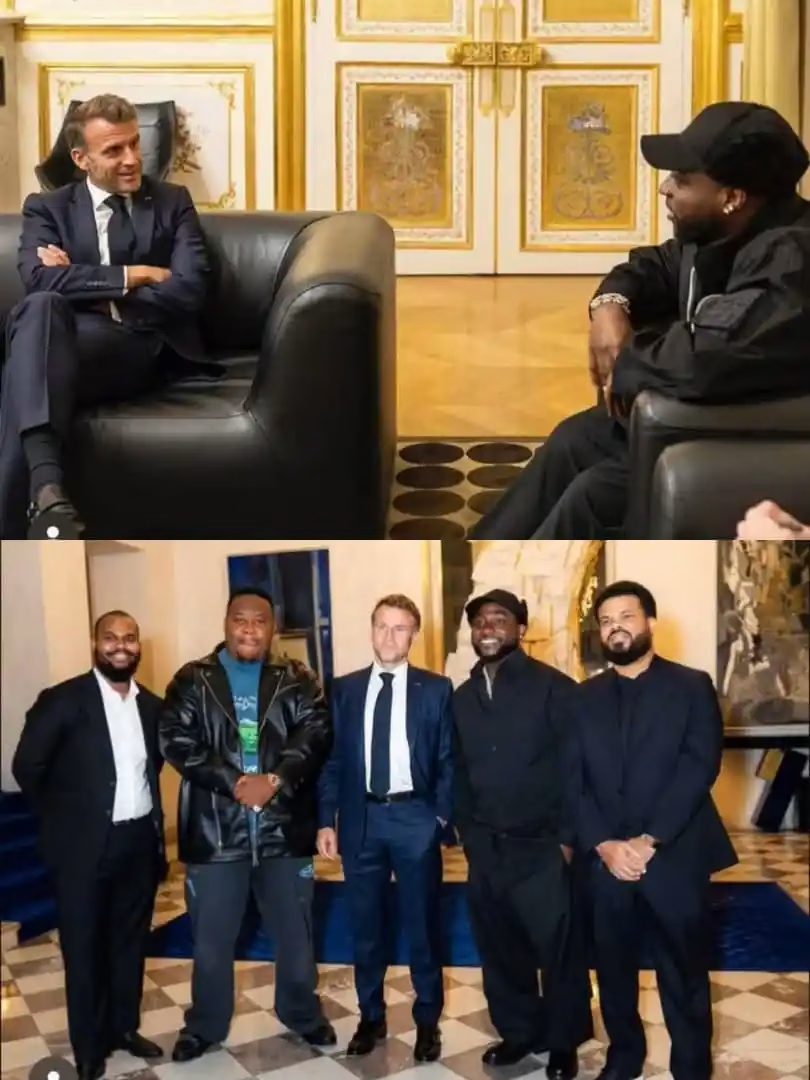
Nigerian singer, David Adeleke , popularly known as Davido, has met with French President Emmanuel Macron to discuss cultural exchange and ways to foster a more connected global community.

The Nigerian superstar shared news of the meeting on Thursday through his X (formerly Twitter) handle, where he expressed gratitude for the experience.

“It was an honor meeting @EmmanuelMacron and sharing our visions for a better world,” he wrote.

Photos posted online captured Davido with President Macron, accompanied by entertainment entrepreneur Cubana Chief Priest and his manager.

The meeting marks another major international engagement for Davido, underlining his expanding impact on global culture beyond the music industry.

How Public Policy Can Fix Nigeria — Insights from DIG Oyebade’s Leadership Course 56 Lecture at NIPSS


Retired Deputy Inspector-General of Police and National Institute for Policy and Strategic Studies (NIPSS) Directing Staff, DIG Adeleye Olusola Oyebade mni, has called for a renaissance in Nigeria’s governance architecture through policy-driven leadership anchored on evidence, accountability, and inclusiveness.

Delivering a paper titled “Concepts, Theories and Features of Public Policy” to participants of the Policy, Strategy and Leadership Course 56, Oyebade asserted that effective public policy is the antidote to Nigeria’s governance failures, providing the framework for national stability, growth, and social justice.

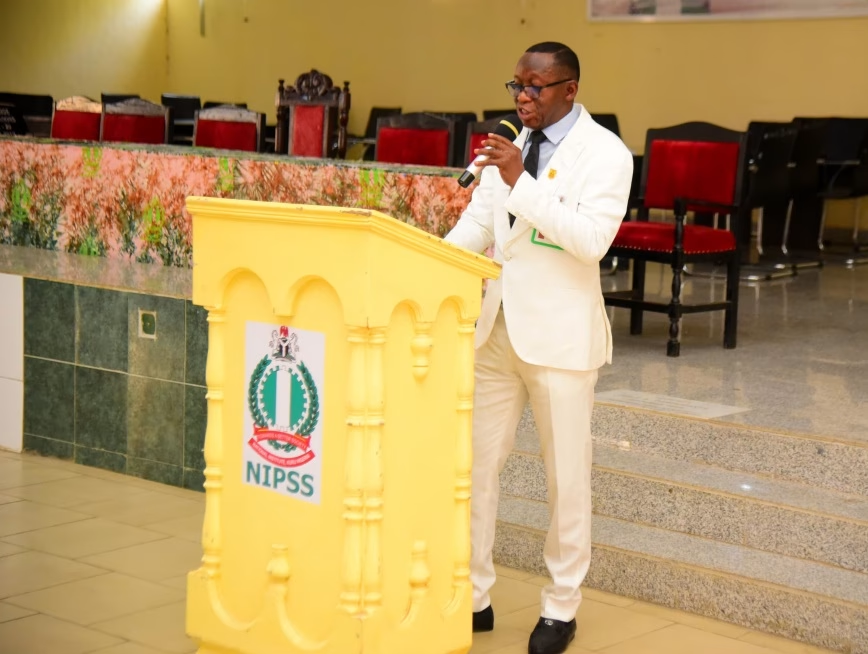
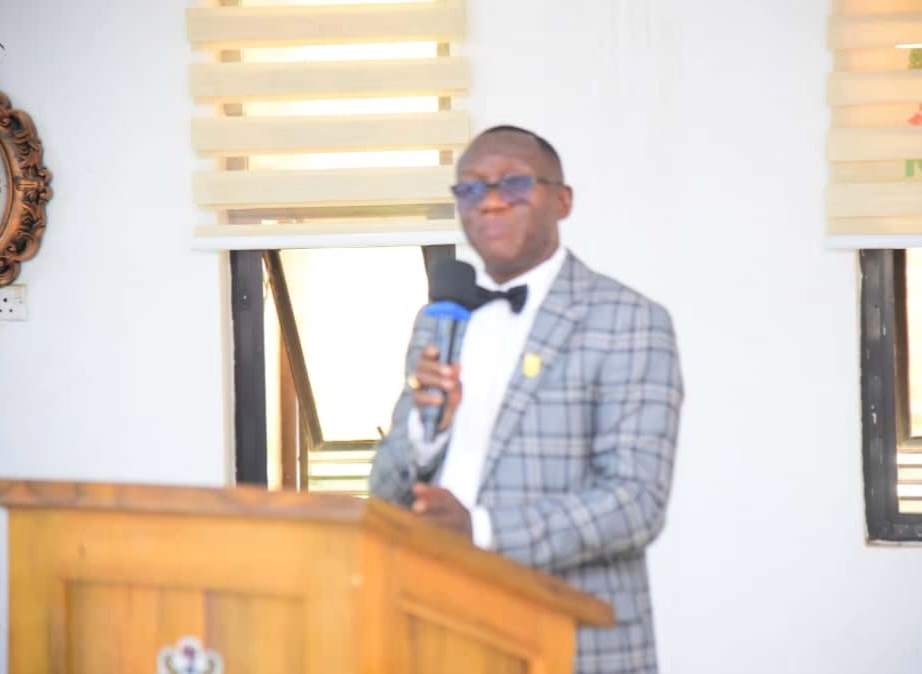
DIG Leye Oyebade delivering the Leadership Course 56 Lecture at NIPSS, Kuru, Plateau State.


Oyebade described public policy as the “foundation of good governance and public administration,” stressing that it translates political vision into tangible programmes that impact citizens’ lives.

“Public policy is not just about government decisions,” he said, “it is a reflection of how power, values, and resources are managed to achieve collective goals.”

According to him, the complexity of modern governance, from poverty and inequality to technological disruptions and climate change, demands strategic policymaking rooted in research, consultation, and adaptability.

The former police chief, who now mentors senior leaders in strategy and policy development, emphasized that Nigeria’s progress hinges on its leaders’ ability to understand and apply the principles of public policy.
He dissected key theories shaping public policy, including InstitutionalGroupEliteRational Choice, and Incremental Theories, explaining how each influences decision-making and governance outcomes.

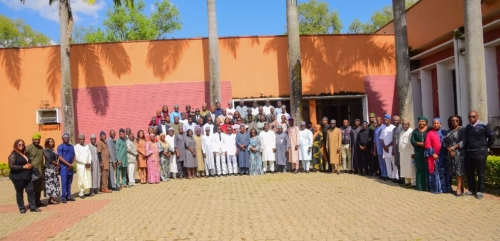
Retired DIG Leye Oyebade with the participants after the Leadership Course 56 lecture delivered at NIPSS, Kuru, Plateau State on October 21, 2025.


“Leaders must see policy as a living system – dynamic, interconnected, and value-laden,” Oyebade said. “Without sound policy, even good intentions fail. But with coherent, goal-driven policies, nations thrive.”

Highlighting the features of effective public policy, Oyebade noted that legitimacy, goal orientation, accountability, and adaptability remain crucial for success. He urged participants to ensure every policy they design or implement serves the public interest and reflects inclusivity, transparency, and ethical governance.

He outlined four policy categories – distributive, regulatory, redistributive, and constituent, stressing that each must align with Nigeria’s broader developmental goals.


Oyebade further warned against policy inconsistencybureaucratic inertia, and political manipulation, which he described as chronic weaknesses undermining Nigeria’s institutional progress.

In his closing remarks, Oyebade encouraged participants to use their NIPSS experience to champion reform and innovation in governance.

“Leadership without policy is like navigating without a compass,” he said. “Nigeria needs leaders who can think strategically, act ethically, and make evidence-based decisions for the common good.”He added that a clear understanding of the policy process, from formulation to evaluation, will empower leaders to translate vision into action and build public trust.The lecture concluded with a call for policy coherence across Nigeria’s public institutions, urging that reforms should not be reactionary but deliberate, data-driven, and adaptive to changing realities. Oyebade maintained that public policy is the bridge between leadership vision and societal transformation, and mastering it is the hallmark of strategic leadership.

Anambra Gubernatorial Election: CP Orutugu Visits Nnewi Area Command To Evaluate Personnel Readiness, Interacts With Stakeholders For Peaceful Polls

By Ebinum Samuel


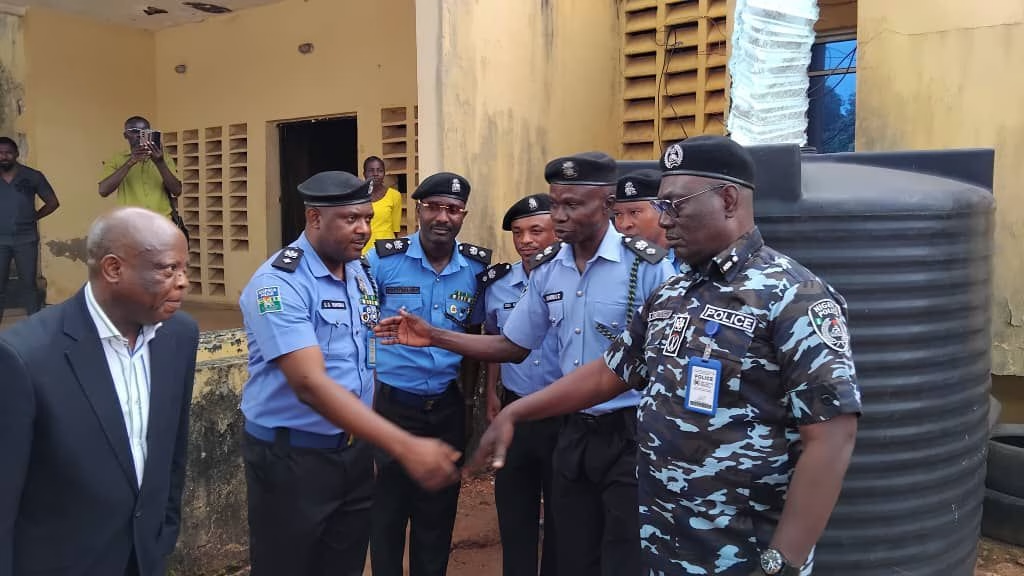
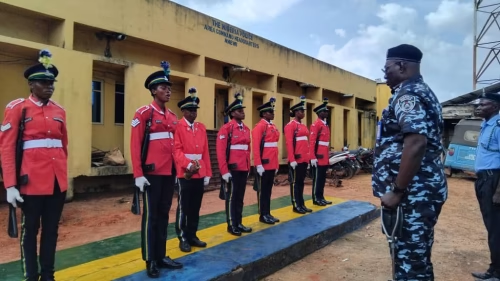
In furtherance of strategic preparations ahead of the forthcoming Anambra Gubernatorial Election scheduled for 8th November 2025, the Commissioner of Police, Anambra State Command, CP Ikioye Orutugu, fwc, minps PhD visited Nnewi Area Command on 22nd October 2025. The visit, according to the Command’s spokesman, SP Tochukwu Ikenga, was a part of his ongoing tour to assess the readiness of personnel and formations for effective election security operations across the State.

During the visit, the Commissioner of Police charged officers under the Area Command to remain professional, vigilant, and impartial in the discharge of their duties before, during, and after the election. He reminded them of the Inspector-General of Police’s directive on maintaining the highest standards of conduct and ensuring that the Nigeria Police Force remains a neutral arbiter in the electoral process.


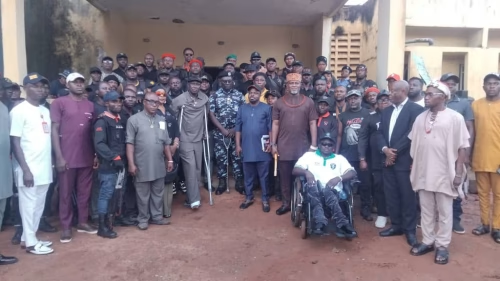
CP Orutugu also held an interactive session with critical stakeholders in the Nnewi area, where he reiterated the IGP’s directive on land-related matters, emphasizing that individuals should always seek justice through competent courts of law. He further appealed to Ndi Nnewi to show greater interest in joining the Nigeria Police Force, noting that such participation enhances representation at the Federal level and strengthens patriotism within the community.

In their separate remarks, the stakeholders appreciated the visit and commended the proactive measures being taken by the Anambra State Police Command to ensure a safe and peaceful election across the State.


The Area Commander, Nnewi, ACP Augustine Oyamiele, also thanked the Commissioner of Police for the visit, assuring him of the Area Command’s full commitment to upholding professionalism and ensuring a hitch-free election.


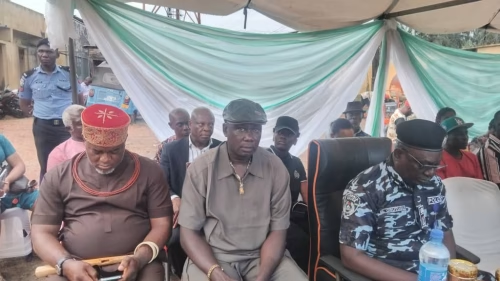
In attendance were representatives of the Local Government Chairman, representatives of traditional rulers, Presidents-General of various communities, members of the Police Community Relations Committee (PCRC), and other security stakeholders in the area.

Alleged forgery: Presidency under pressure to probe Interior Minister’s NYSC certificate saga


The Presidency has confirmed receipt of a formal petition calling for the Minister of Interior, Olubunmi Tunji-Ojo, to step aside pending a thorough investigation into allegations concerning his National Youth Service Corps (NYSC) discharge certificate, reportedly issued in 2023.

According to reports, the petition was submitted on Tuesday by a coalition of civil society organizations and addressed to President Bola Ahmed Tinubu through the Chief of Staff. A copy of the petition was also forwarded to the Chairman of the Code of Conduct Bureau (CCB).

The coalition described the case as “a constitutional and ethical matter that strikes at the very heart of integrity, justice, and public accountability,” insisting that no government official should be shielded from scrutiny.

According to the petition, Tunji-Ojo was first mobilised for the NYSC scheme in 2006 at the age of 24 but allegedly absconded from service.

The NYSC, the petitioners claimed, officially confirmed that the minister did not complete his one-year mandatory service.

Thirteen years later, in 2019, Tunji-Ojo was said to have been re-mobilised to complete his service year.

However, during that same period, he was serving as a member of the House of Representatives, representing Akoko North-East/North-West Federal Constituency of Ondo State — a dual role that, according to the coalition, violated constitutional provisions prohibiting public officers from holding two remunerated positions simultaneously.

Despite reportedly completing the service in 2020, no discharge certificate was issued at the time.

The groups alleged that a new certificate mysteriously surfaced in 2023, signed by an NYSC Director-General who was not in office during the purported service year.

The NYSC’s explanation — that Tunji-Ojo’s name was “omitted during printing” — was dismissed by the petitioners as “suspicious, irregular, and inconsistent with established NYSC administrative procedures.”

The coalition cited several laws that may have been breached, including: Sections 2 and 13 of the NYSC Act, which criminalize absconding from service or using forged NYSC certificates; Paragraph 2, Part I of the Fifth Schedule to the 1999 Constitution, which prohibits public officers from receiving salaries from more than one public office; and Sections 19 and 25 of the ICPC Act, which prescribe up to seven years’ imprisonment for any public officer who receives double remuneration or acts corruptly.

They argued that if Tunji-Ojo indeed participated in the NYSC programme while serving as a federal lawmaker, it would constitute “an abuse of office, conflict of interest, and violation of the Code of Conduct for Public Officers.”

The petitioners also accused the Tinubu administration of selective justice, referencing the resignation of a minister from the South-East over certificate irregularities.

“Just as a minister from the eastern part of Nigeria was asked to resign pending investigation over certificate irregularities, the same standard of accountability must apply to Minister Bunmi Tunji-Ojo,” the coalition wrote. “Justice must not wear ethnic or political colours.”

The coalition outlined four major demands: That Hon. Bunmi Tunji-Ojo step down immediately to allow for an independent investigation; That the Presidency direct the NYSC, ICPC, and Code of Conduct Bureau to investigate the authenticity of the 2023 certificate; That the National Assembly open an inquiry into possible double remuneration between 2019 and 2020; That the issue be treated as a matter of national integrity, not political affiliation.

The coalition urged President Tinubu to act “decisively for history, for justice, and for Nigeria.”

“This is not merely about Bunmi Tunji-Ojo — it is about whether the rule of law still governs our democracy,” the petition stated.

“If selective justice is allowed to stand, it will erode public confidence in government institutions and deepen cynicism.”

Anambra: Showing the way forward as Nigeria’s golden opportunity for heritage tourism


As edited by Ayo Oyoze Baje,


According to Mr Don Onyenji, the honorable Commissioner for Tourism, Arts and Culture in Anambra state.heritage has become a powerful driver in the global tourism economy. From Kyoto in Japan, where centuries-old temples and geisha traditions continue to draw millions annually, to Fez in Morocco with its ancient medina, musical heritage and craftsmanship, destinations are leveraging their culture and investing in their historic sites and cultural resources as a competitive tool to attract visitors.


Heritage tourism accounts for nearly 40 per cent of all international tourism, according to the United Nations Tourism (UN Tourism). A market analysis report by Grandview Research shared that the global heritage tourism market was valued at approximately US$605 billion in 2024, and is projected to grow by 4.5 per cent annually from 2025 to 2030.


What exactly is this new sense of appreciation for heritage tourism, one might ask? It stands to reason that in the evolution of the tourism industry, people start to ask for more from their destination. Beyond a nice hotel or resort, there is a timeless quest for meaning, identity and connection. “Travel far enough, you meet yourself,” the popular Hemingway quote says. Even as travelling helps us to connect more with others, it also contributes to helping us understand more about ourselves, as we begin to understand our perspective through the lens of seeing how others have navigated similar challenges and experiences. Travel provides a sense of wisdom that can only be gained through exploration.


Global tourism trends point to the tourist of the future seeking more meaningful experiences that are designed for reflection, interaction and provide a chance to connect with the local community. Well-established tourist destinations are investing heavily in heritage tourism, as a contributor to authentic experiences. This is particularly challenging for the more established destinations who have to reinvent themselves, and in some cases, like in Italy and Spain, have had to grapple with issues of overtourism and the commoditization of experiences.


Closer to home, Ghana’s “Year of Return” campaign in 2019, attracted over one million visitors and generated US$1.9 billion in tourism revenue. Across the West Africa region, there are comparable cultural resources that can be developed to boost the tourism economy. In Nigeria, our tourism potential remains underharnessed, and this presents an opportunity to take advantage of the global trend towards heritage tourism, which could not have come at a more opportune time. Our natural and cultural heritage remain our unique value proposition, providing experiences that cannot be found anywhere else in the world. We simply need to make these experiences visitor-ready, and with coordinated delivery and strong branding, we can be positioned within the US$605 billion global heritage tourism market.


Home to over 370 ethnic groups, Nigeria is one of the most ethnically diverse nations in the world , each community carrying its own language, history, cuisine, customs, and cultural identity. From the ancient Benin Kingdom and Nok Civilization to the Arochukwu Long Juju Slave Route and the Ifá Corpus of the Yoruba, our heritage wealth is vast and distinctive. For now, Nigeria remains underrepresented on the global map of thriving heritage destinations, but not for long.


Anambra State is leveraging its rich cultural assets to drive sustainable tourism development. Known for its deep Igbo heritage, entrepreneurial spirit, and forward-looking development agenda, the state is positioning culture as a key pillar of its economic growth. Sites such as the Ogbunike Caves, Owerre-Ezukala Caves, and Agulu Lake, among others, have been shortlisted for development and investment as anchor projects for heritage tourism development.


The Anambra State Government is developing its Heritage Tourism Development Masterplan, working with Red Clay, a tourism advisory practice, to transform its cultural and natural heritage into meaningful experiences for residents and visitors alike. The goal is to enhance Anambra’s tourism offerings through immersive experiences that balance innovation with respect for tradition, as a way This initiative is setting a new benchmark for heritage-driven economic development in Nigeria.


Heritage is uniquely place-based. It cannot be outsourced or replicated. It supports local artisans, historians, storytellers, musicians, local transport, fashion, food, tour guides, etc., building an entire ecosystem around community-based economic growth. The potential impact on employment and rural revitalization of this interconnected tourism ecosystem, at a conservative estimate will lead to the creation of about 5,000 direct jobs annually with a multiplier effect of up to tenfold in indirect employment that will emerge from tourism development of the shortlisted sites.


In Anambra State, the vision of the governor, Professor Chukwuma Charles Soludo, CFR, is to transform the state into a thriving mega city , a place to live, work, and play. A key part of this vision is positioning Anambra as a leading destination for tourism in Nigeria. The Governor has already completed and commissioned Solution Fun City, the largest fun centre in Nigeria, which is now operational. Building on this momentum, the State is preparing to launch its Heritage Tourism Masterplan as a living document to guide the sustainable development of heritage tourism and unlock the wider tourism economy. This initiative will establish Anambra as Nigeria’s preferred destination for heritage tourism, attract investment in essential infrastructure (including roads, signage, visitor information centres, and accommodation), and empower local communities, traditional leaders, custodians, and artisans as key partners in its implementation. Through heritage tourism, we aim to create interconnected tourism circuits linking sites across the state and the wider region, enhancing domestic and regional tourism.


As we continue to play our part in developing tourism in Nigeria, we are equally committed to helping reposition the country as a leading heritage tourism destination. Our stories, history, festivals, and traditions already hold immense value, they simply need to be organized, developed, and presented with the strategic intent they deserve.


Heritage tourism is a powerful development tool, for economic and social transformation and Anambra State is positioned to harness this a new frontier of growth, to create jobs and enhance the well-being of Anambrarians.


Mr Don Onyenji is the Commissioner for Tourism, Arts and Culture in Anambra State.

NIPSS: DIG Oyebade Calls for Emotionally Intelligent Leadership in Nigeria’s Security Sector


  • Ex–Police Chief Delivers Strategic Lecture on Negotiation, Conflict Management, and Command Responsibility

Segun Atanda/

Retired Deputy Inspector-General of Police and Directing Staff at the National Institute for Policy and Strategic Studies (NIPSS), DIG Adeleye Oyebade, mni, has urged Nigerian security agencies to elevate their approach to leadership by integrating negotiation, conflict management, and emotional intelligence into command strategy.

Delivering a thought-provoking lecture at the Strategy Course for Command Responsibility, Cyber-Security, and Intelligence Management (SCCR 14), Oyebade emphasized that the future of Nigeria’s security architecture depends not only on tactical capability but on leaders who can “think, communicate, and influence as effectively as they can command and control.”

The session was convened at the invitation of the Acting Director of Studies, Barr. N. Salan Mann, mni, as part of NIPSS’ advanced capacity development programme for mid- and senior-level security and intelligence officers.

Oyebade argued that contemporary security challenges, ranging from insurgency and banditry to cybercrime and communal unrest, are rooted in human relationships and grievances rather than brute force.

Retired DIG Leye Oyebade (middle, front row) with participants at the Strategy Course for Command Responsibility, Cyber-Security, and Intelligence Management (SCCR 14), at NIPSS, Kuru, Plateau State.

“Force may silence the gunfire temporarily,” he said, “but dialogue, understanding, and trust sustain peace.”

He explained that effective officers must be skilled negotiators capable of engaging community leaders, local politicians, and even non-state armed actors under pressure, with the goal of preventing escalation while maintaining institutional legitimacy.

Drawing from inter-agency experiences across the armed forces, police, and intelligence services, Oyebade described conflict management as “a critical command responsibility that determines operational success, force protection, and public confidence.”

He cited real-world examples, such as clashes between military and police units in Taraba State and coordination issues in multi-agency operations, to underscore the need for clear command structures, early communication, and institutional respect among security bodies.

“Recognizing mandates, demonstrating professionalism, and applying empathy,” he said, “can turn potential clashes into cooperation.”

Referencing Daniel Goleman’s model of Emotional Intelligence, Oyebade highlighted self-awareness, self-management, social awareness, and relationship management as essential competencies for modern command.

He noted that emotionally intelligent officers can de-escalate tense encounters, interpret unspoken motivations, and maintain composure in crises.

“An officer who can not manage his emotions can not manage a team,” he said.

In the cyber and intelligence domains, he added that emotional intelligence enables collaboration across agencies such as the DSS, NITDA, and ONSA, especially when managing sensitive data and jurisdictional overlaps.

Oyebade called for the institutionalization of emotional intelligence and conflict management training across all security agencies, supported by counselling, stress management, and reflective leadership programmes.

He concluded that negotiation, empathy, and self-discipline are now as vital to Nigeria’s national security as operational strategy or weaponry.

“The leaders Nigeria needs today are those who can fight and plan, but also negotiate wisely, manage conflict constructively, and lead with emotional maturity,” he said.

The key recommendations by the retired DIG are:

  1. Incorporate emotional intelligence into all command and staff courses.
  2. Establish conflict resolution frameworks across security agencies.
  3. Institutionalize psychological and stress-management support for officers.
  4. Promote reflective and adaptive leadership at all operational levels.
  5. Strengthen inter-agency communication for coordinated national response.
 

Defence Headquarters Dismisses Rumoured Coup Plot Against Tinubu as ‘Nonsense’

The Defence Headquarters (DHQ) has debunked claims by an online publication alleging that the cancellation of activities for Nigeria’s 65th Independence Anniversary was linked to an attempted military coup.

In a statement issued by the Director of Defence Information, Brigadier General Tukur Gusau, the military described the report as false, malicious, and deliberately crafted to create fear and distrust among Nigerians.

According to General Gusau, the referenced publication also misinterpreted a previous DHQ statement concerning the arrest of 16 officers currently under investigation for professional misconduct. He clarified that the investigation was a routine internal process aimed at maintaining discipline and professionalism within the Armed Forces of Nigeria (AFN).

Read Also: President Tinubu Commends Olukoyede Over Impressive Asset Recovery, Conviction Records

“The decision to cancel the 65th Independence Anniversary parade,” he explained, “was made to enable President Bola Ahmed Tinubu attend a strategic bilateral meeting abroad, and to allow military formations sustain focus on ongoing counterterrorism, anti-insurgency, and anti-banditry operations.”

The Defence Headquarters reaffirmed its loyalty to the Constitution and to President Tinubu, emphasizing that the Armed Forces remain committed to protecting democracy and national unity.

“The public is advised to disregard the baseless claims spread by mischief makers,” the statement read. “The AFN remains steadfast in its constitutional duty to defend the nation and support the democratic institutions of government.”

Our Children’s Anthem


By Ayo Oyoze Baje


Quote:


“We are the children of the poor

Born without our mothers’ consent

Tortured without a protest

Buried without a name”


-Ayo Oyoze Baje ( poem of the same title, published by the Nigerian Herald, July 1988 )


When we blame our youths for the escalating wave of sundry crimes such as armed robbery, kidnapping for ransom, rape and terrorism we hardly ask ourselves if we, as their parents, guardians and elders have been there for them, or playing our parts. Yet, the pertinent questions remain: Do the perpetrators of these heinous crimes appear from Planet Mars or Jupiter? Don’t they have parents, teachers, pastors or Imams as their guiding moral compass? Have the governments (local, state and federal) acted as the father-figure to provide for their welfare and protect them against social and food insecurity as aptly enshrined in Section 14,Sub section 2(b) of the 1999 Constitution,(as amended)? The answer is obvious.


These were similar questions yours truly raised through an article titled: ‘ What type of future are we leaving for our children?’ as severally published on October 12, 2017. But has the sordid situation improved as at this day? Not at all. It has worsened, as parents groan with the highest inflation ever characterized by soaring costs of food items, electricity tariff, rent, and school fees all triggered by the sudden removal of fuel subsidy back in May 2023. Yet, while some 133 million citizens grapple with the survival mode, the children of the rich political helmsmen live large; openly displaying their frivolous lifestyle to satisfy their epicurean taste as if they were elected along with their parents into office. As if that was not insulting enough, turning our democracy into oligarchy, recently the Revenue Mobilization Allocation and Fiscal Commission, RMAFC came out proposing to increase the pay packages of the Lord’s of the Manor by over 100%! Outrageous, is it not? Of course, it is like adding salt to the people’s injury.


In response, the Nigeria Labour Congress, NLC has described it as “insensitive, unjust and inequitable”.On his part, renowned human rights advocate and lawyer, Femi Falana has raised alarm over it, warning that the economic situation is in dire straits and the RMAFC, which is making the proposal for the second time in two years ought to have considered giving a listening ear to the cries of the long-suffering, marginalized masses. In fact, methinks, this should be a moment for sober reflection.

What we need is leadership by example- a selfless service to the people. Now is the time for them to make the much needed sacrifice, instead of turning our democratic culture to that of plutocracy, which is a government of the rich, by the rich and to reward the supporters of the political pilots. Indeed, they should borrow a fresh leaf from some past political leaders of some other countries such as Italy and Uruguay, when their nations were faced with harsh economic situation as we currently battle with.


It would be recalled that between 2010 and 2015 when

President Jose Mujica ( now of blessed memory) piloted the affairs of Uruguay he shunned the luxurious house that the Uruguayan state provided for its leaders. He opted instead to stay at his wife’s farmhouse, off a dirt road outside the capital, Montevideo.


The president and his wife worked the land themselves, growing flowers. They had only two cars.This austere lifestyle – and the fact that Mujica donated about 90% of his monthly salary, equivalent to $12,000 (£7,500), to charity – led him to be labelled the “poorest president in the world”.


In a similar vein, it was reported in May 2021 that Italy’s Prime Minister known as ‘Super Mario’ waived his entire £100,000 salary to ‘show solidarity with his nation hit by recession’. Leadership by example was what the two men with the sweet milk of human kindness demonstrated, when their two countries were caught in the web of economic recession, not an obscene lifestyle.


It is the best of times for our own political leaders- from the local government chairmen, through the lawmakers at all levels to the state governors and the federal executive

to climb down from their high horses of ego tripping to wear the tattered shoes of the common man and do the needful. Lest we forget the World Bank, International Monetary Fund,IMF and the Economist Magazine published in the United Kingdom,UK warned

back in 2010 that the humongous salaries of our politicians in office ranked amongst the highest in the world then while the people stew in persisting, preventable poverty. Unfortunately, their words of admonition fell on stone – deaf ears.


Let us for a moment consider the mind-boggling and humungous sums of public funds serially siphoned to feather the nests of members of the political class ever since independence in 1960.Couldn’t that have facilitated in providing quality education, sustainable food security, sound healthcare delivery and the enabling infrastructural environment to provide mass employment for the youths?


Another source of serious concern is the inability of some state governments to pay the minimum wage, up till the moment, as agreed.

We should recall that President Bola Tinubu signed the new minimum wage into law on July 29, 2024, after meeting with leaders of the Nigeria Labour Congress and the Trade Union Congress of Nigeria.Yet, in spite of the monthly allocations from the Federation Account and their Internally Generated Revenue,IGR some civil servants and their dependants are left in misery.


Indeed, one’s increasing fear about the nature and texture of the future the current crop of Nigeria’s political leaders is bequeathing to our rudderless youths is predicated on the prevailing poverty and hunger in the land. Consider the scary scenario where instilling the Fear Factor on a hapless, hungry citizenry through well calculated punitive measures are meted out on the voices of courage and truth who dare criticize government’s policies? What do we make of the sudden swerve of defections, especially by some state governors who are afraid of being investigated for one case of corruption or the other all in the bid to hang on to political power come the next election? All these, in addition to the evils of vote trading- selling and buying -are antithetical to democratic norms


Our leaders should be worried about the moral lessons they are teaching our children, who have to grow up daily in hunger and misery, in a thorny, political jungle where might is right. What we need is the deployment of our best brains including eggheads on the economy to come up with pro-people policies with the enabling environment for businesses to thrive. We have abundant natural resources to get Nigerians out of the ignoble pit of poverty with the right leadership policies driving the economy. Not the time for the poor to tighten their belts to keep satisfying the insatiable political elite, as the RMAFC wants done with increased pay packages.