www.newstower.ng

Anambra Governorship Election:PSC Chairman Warns Against Police Misconduct, Deploys Staff Monitors  

By Ebinum Samuel 


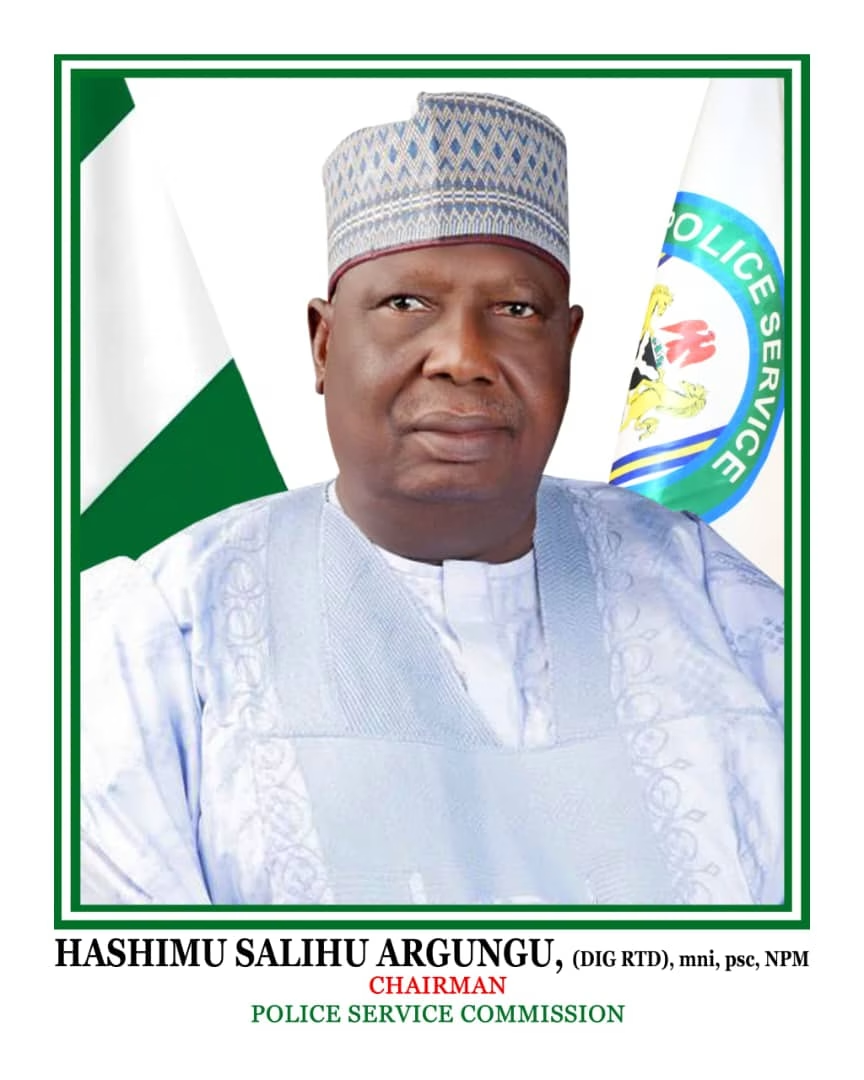
Police Service Commission Staff Monitors have been deployed to the three Senatorial zones of Anambra State to monitor Police conduct during this Saturday’s Governorship election in the state.


National Coordinator and Chairman of the Commission, DIG Hashimu Argungu rtd mni has warned that Police Officers on electoral duties must exhibit a high level of impartiality and discipline and must ensure that both the electoral officers and the electoral materials are protected.


The Commission’s spokesman, Ikechukwu Ani disclosed that Argungu also directed that the Police men on election duty must ensure that a conducive environment is created for the people of Anambra state to vote without let or hindrance adding that Officers who compromise their rules of engagement will be sanctioned.


DIG Argungu said the Anambra election should be a test case for the Police as the nation prepares for the 2027 General elections.


He expressed happiness with the preparations so far put in place by the Anambra state Police Command especially the State Commissioner CP Ikioye Orutugu, fwc, PhD who according to reports has recently visited all the Area Commands and known flash points in the state to underscore the readiness of the Police to ensure a free and fair election.


DIG Argungu said the Commission will appreciate officers who exhibit professionalism and commitment during the election and would sanction those who will be found wanting.


The Commission staff Monitors will operate from the state capital and the three Senatorial Districts of the state.

Anambra CP Orutugu Concludes Election Security Advocacy With Awka Area Command

By Ebinum Samuel


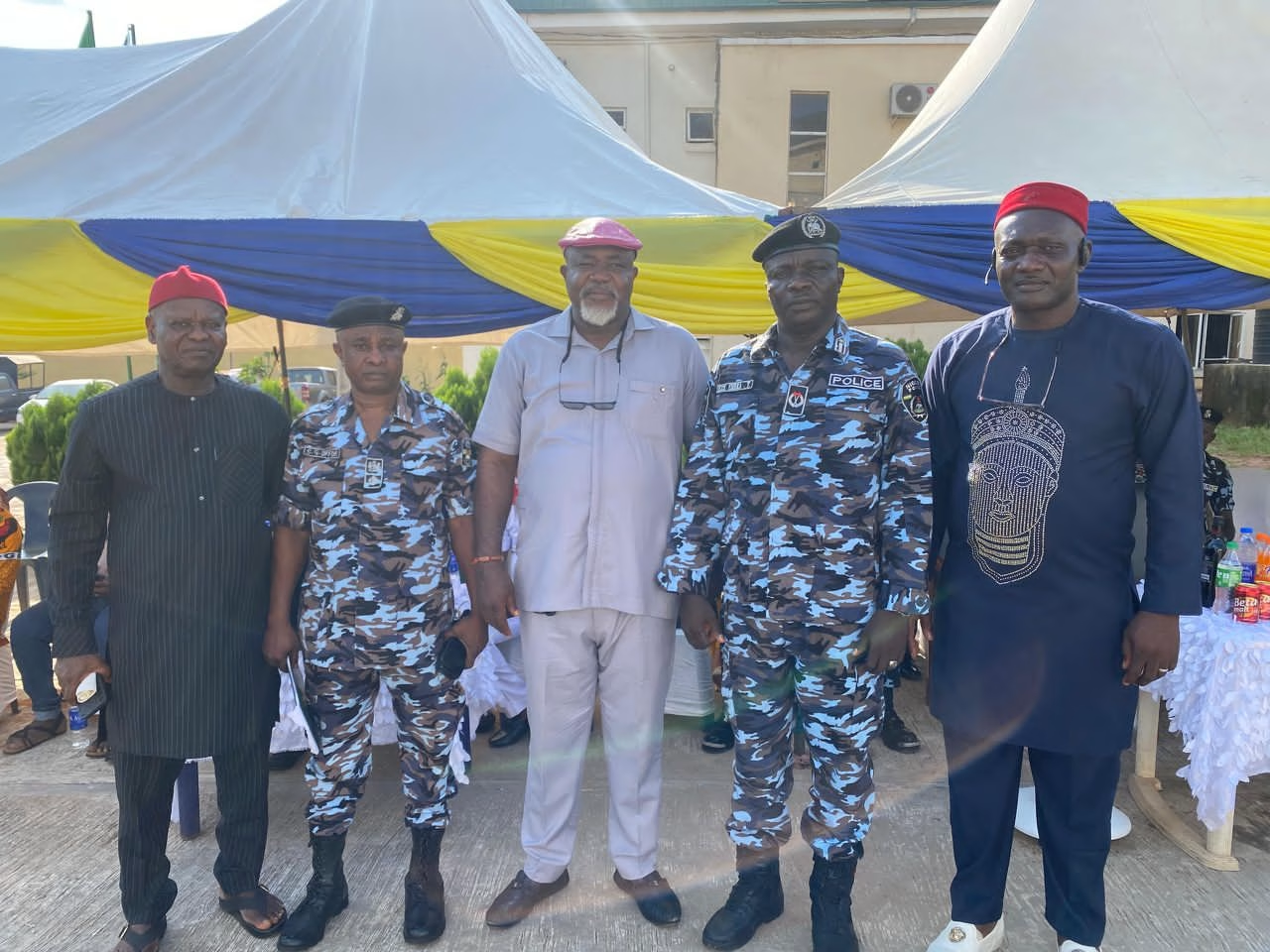
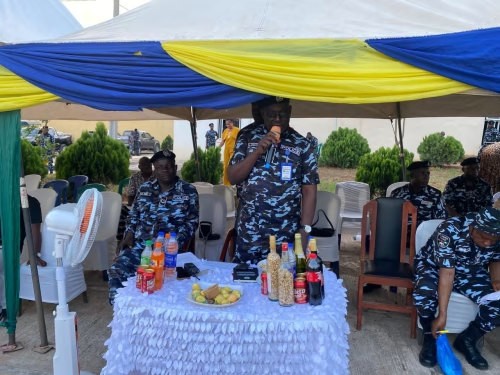
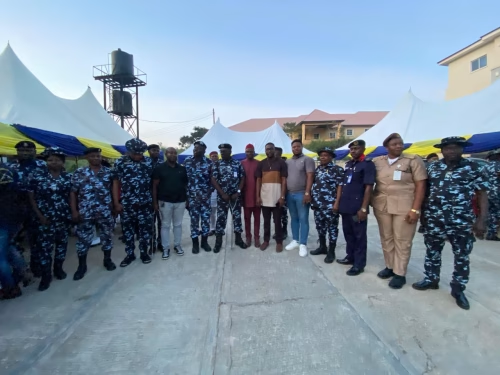
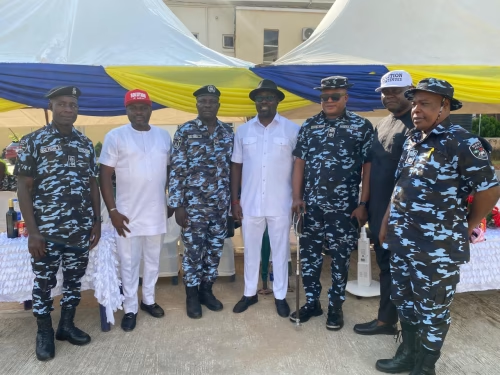
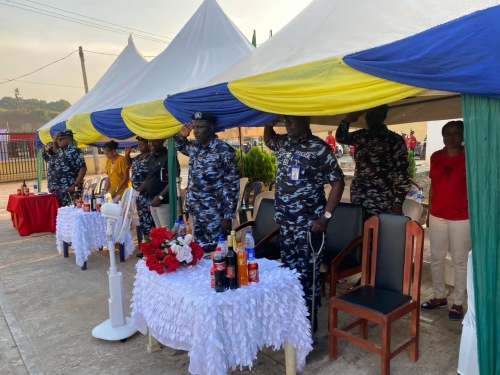
As part of the Command’s continuous statewide engagement ahead of the forthcoming Anambra Governorship Election, the Commissioner of Police, CP Ikioye Orutugu fwc minps PhD on 1st November, 2025, concluded his Election Security Advocacy Tour with the officers and men of the Awka Area Command.


The meeting, held at the Area Command Headquarters, Awka, marked the final phase of the Command’s strategic sensitization and capacity- strengthening engagements designed to prepare personnel for professional and effective election security operations.


In his address, CP Orutugu commended the officers for their dedication and discipline throughout the advocacy campaign, which has so far covered all Area Commands and Divisions in the State. He emphasized the importance of neutrality, professionalism, and respect for human rights during election duties.


The CP reiterated that the Anambra State Police Command remains fully prepared and fortified for the protection of lives and property before, during and after the election. He assured residents that all tactical units, intelligence teams, and patrol formations have been placed on heightened alert, with adequate logistics support and coordination among sister security agencies.


CP Orutugu further charged the officers to maintain vigilance, demonstrate courage, and uphold the core values of the Nigeria Police Force in ensuring that peace and order prevails throughout the electoral process.


He also used the opportunity to encourage members of the public to remain law-abiding and security-conscious, assuring that the Police will continue to collaborate with communities and stakeholders to guarantee a peaceful and credible election.

The coup that dare not speak its name, By Farooq Kperogi


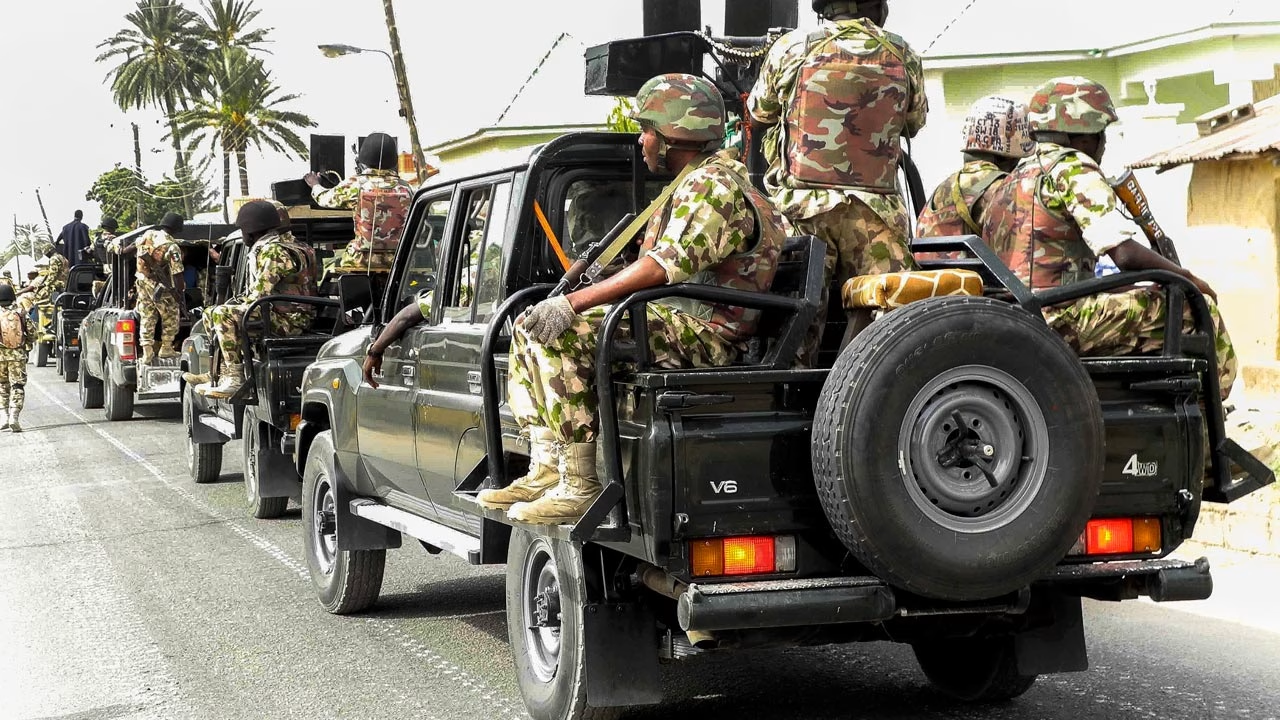
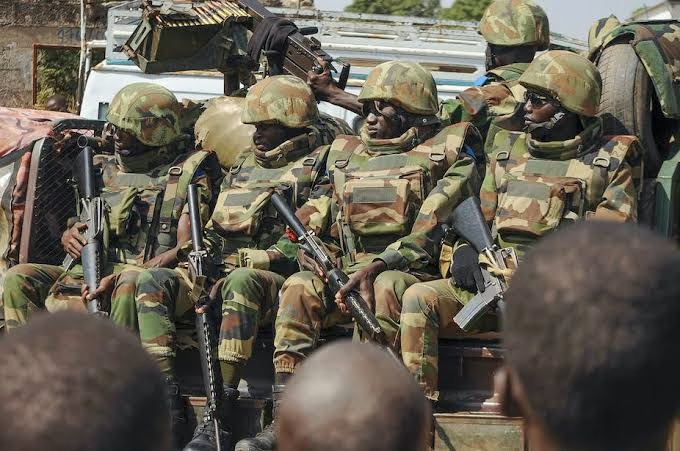
was initially disinclined to write about the alleged attempted coup to dislodge President Bola Ahmed Tinubu from power because the Defence Headquarters (DHQ) has publicly denied it and characterized news reports suggesting that it did happen as “false and misleading.”

News of the coup attempt was first exclusively reported by Sahara Reporters. The report came two weeks after the Director of Defense Information, Brigadier General Tukur Gusau, signed an October 4 news release that said 16 officers had been arrested and would face “military justice” over “issues of indiscipline and breach of service regulations.”

The military’s investigations, Gusau said, found that the 16 officers’ grouse “stemmed largely from perceived career stagnation cause by repeated failure in promotion examination, among other issues.”

That, at first glance, appeared to be an ordinary disciplinary matter. Armies, like all bureaucracies, struggle with ambition, thwarted aspirations, and internal politics.

Sahara Reporters took that explanation and detonated it. The platform reported that the detained officers were not disgruntled mid-career soldiers sulking over promotion bottlenecks. They were alleged coup plotters. Then things escalated.

Then things escalated. Premium Times, which is famous for exercising editorial restraint and avoiding sensational political speculation, confirmed the thrust of the report. “The report is true,” Premium Times quoted a “military source familiar with the matter” to have told them.

Daily Trust independently corroborated the same details. Both could not have lightly risked their reputational capital by echoing Sahara Reporters without high-confidence sourcing.

Premium Times even repeatedly amplified its story across social platforms in a manner that signaled editorial certainty rather than sensational opportunism.

But beyond throwing around lazy, sterile, stereotyped, ready-made adjectives to dismiss the report of the coup, the Defense Headquarters hasn’t said anything of substance to dispute the facticity of the reports about the coup. No counter-facts. No evidence contradicting the reporting. Denial, in institutional crises, loses persuasive power when it fails to offer credible, granular alternative explanations.

The implausibility of the denials reached comedic levels when authorities attempted to explain President Tinubu’s abrupt cancellation of Nigeria’s Independence Day parade. They claimed the president needed to attend a sudden, unspecified bilateral meeting abroad and that the parade would distract the Armed Forces of Nigeria from fighting terrorism and banditry.

That justification collapsed under the most cursory scrutiny. Independence celebrations do not jeopardize counter-insurgency operations. Moreover, no emergency diplomatic engagement materialized that week. Institutions do not peddle obvious falsehoods to hide nothing. The more laughable the cover story, the more likely the secret is real.

Matters intensified when Sahara Reporters released the names of the alleged plotters. Premium Times and Daily Trust again verified key elements of the revelation. The Defence Headquarters, usually swift to debunk anything unflattering, stayed mute. Silence, in this context, was not golden. It was incriminating.

Then came the political earthquake: President Tinubu dismissed and reshuffled top military leadership. The timing was too convenient to be coincidence. Reshuffling service chiefs in the immediate aftermath of coordinated reporting on a coup attempt looks less like routine personnel management and more like crisis containment. These clocks do not run independently. They strike in synchrony.

One additional ripple deepened the intrigue. Sahara Reporters disclosed that security forces raided the home of a former governor, Timipre Sylva, on suspicion of involvement in the alleged plot. His spokesperson confirmed the raid.

Nothing further illuminates the seriousness of a situation than the government’s decision to search the home of a former senior federal official who is close to the northern political establishment.

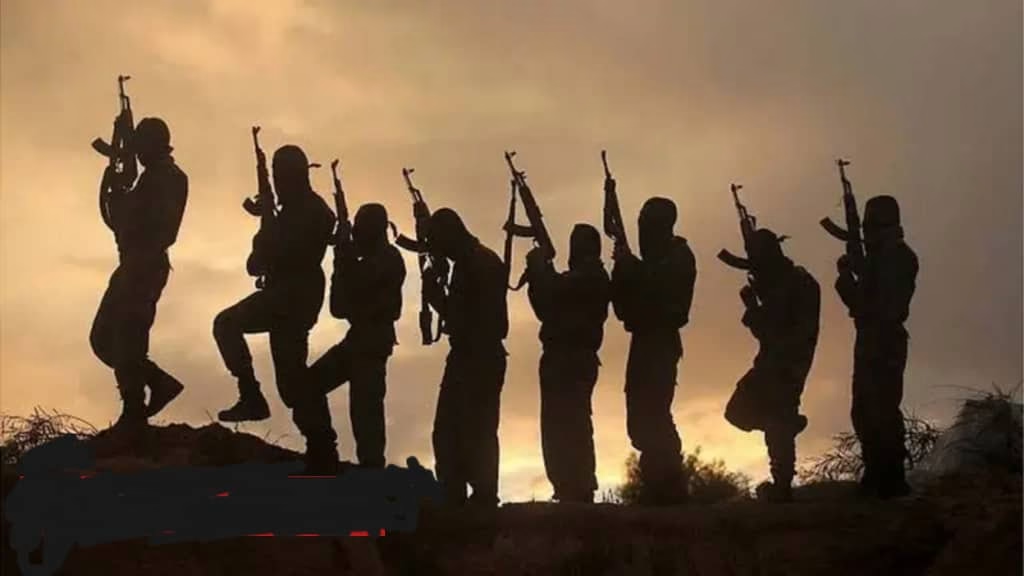
The logical inference, supported by mounting circumstantial evidence, is that Nigeria experienced a coup attempt that did not reach critical mass. The authorities are managing information not to reassure the public, but to avoid panic, prevent copy-cat adventurism, and preserve a veneer of stability for investors and international partners. Political communication by the state has been characterized by opacity rather than candor.

But the surface drama pales beside the subterranean danger. The ethnic and religious composition of the alleged conspirators raises existential questions about Nigeria’s fragile national fabric. Media reports indicate that the detained officers are overwhelmingly northern Muslims from Niger, Nasarawa, Katsina, Gombe, Bauchi, and Jigawa, with only two officers from Plateau and Delta States breaking the pattern.

Whether this distribution emerged by coincidence or design hardly matters. Perception often outweighs empirical truth in moments of national strain.

Had the coup succeeded, Nigeria would have sleepwalked into catastrophe. The South would have interpreted it as a northern Muslim repudiation of a southern presidency. Old suspicions, suppressed but never extinguished, would have surged back into public consciousness.

It would have felt like June 12, 1993 revisited, only with uniforms and guns instead of decrees and judicial machinations. The last time Nigeria faced a crisis of southern electoral legitimacy invalidated by military fiat, the nation nearly splintered.

Peace was restored only when northern elites agreed that a Yoruba president was necessary to stabilize the federation in 1999. That moment, painful and imperfect, was a rare episode of elite consensus for national survival.

A northern-led coup against a Yoruba president today would have ignited resentments more combustible than those of the 1990s. The wounds of June 12 have not fully healed because symbolic injustices linger long after material conditions improve.

Nigerians may be suffering intolerable hardship and spiraling insecurity today, yet economic distress does not erase group memory or neutralize grievance politics. People seldom tolerate perceived humiliation of their collective identity, even when their pockets are empty. In crises framed as existential, identity routinely overwhelms material interests.

This is the cardinal danger that the authorities appear eager to downplay. Nigeria is not merely a geographical expression, to borrow Chief Obafemi Awolowo’s once-controversial phrase. Nigeria is a precarious compact among ethnicities, religions, histories, and anxieties.

Military adventurism, when layered upon identity fault lines, becomes political arson. It is not an assault on one administration. It is an assault on the delicate architecture that keeps the republic intact.

This moment demands two sober reflections.

First, the military must confront its internal contradictions, promotion culture, and factional tensions transparently and responsibly. Armed forces that cannot discipline discontent ethically and lawfully inadvertently invite disloyalty and adventurism. The aborted plot is only a symptom.

Second, the government must resist the reflex to smother inconvenient truths. Secrecy accelerates suspicion. Nigeria’s citizens have matured politically; they can process national challenges without descending into chaos. Shielding the public from reality infantilizes the electorate and breeds cynicism.

Federal cohesion today rests on credibility rather than coercion. The Nigerian constitution is only as strong as the public trust that undergirds it. Democratic legitimacy cannot be defended with half-truths and clumsy denials. It must be upheld with transparency and accountability.

Something serious happened in those barracks. Nigerians can feel it in the tone of the denials, the choreography of the shake-ups, the eerie quiet of usually voluble institutions. The government’s instinct to suffocate the story is understandable, yet it is also counterproductive. The more the truth is suppressed, the more combustible it becomes.

The great paradox of power is that strength grows from candor, not concealment. Nigeria has survived crises more convulsive than this one. It can survive this, too. Survival requires confronting the truth head-on, acknowledging the fissures, and recommitting to democratic stability as a non-negotiable national imperative.

A nation that tiptoes around its dangers invites its downfall. A nation that stares them in the face earns its future. Let Nigeria choose the latter.


Kperogi is a renowned columnist and United States-based professor of  journalism .

Bandits kidnap deputy speaker

The Deputy Speaker of the Kebbi State House of Assembly, Samaila Bagudu, has been abducted by suspected in his hometown, Bagudu Local Government Area.

Witnesses said the attackers stormed Bagudu town on Friday evening, firing sporadically before whisking away the lawmaker. According to the sources, Bagudu was taken shortly after completing his prayers and leaving the mosque for his residence.

The Chief Press Secretary to the Kebbi State Government, Ahmed Idris, confirmed the incident to Channels Television.

Attempts to get more information from the Kebbi State Police Command on the abduction were unsuccessful as of the time of filing this report.

More details are expected to emerge as investigations continue.

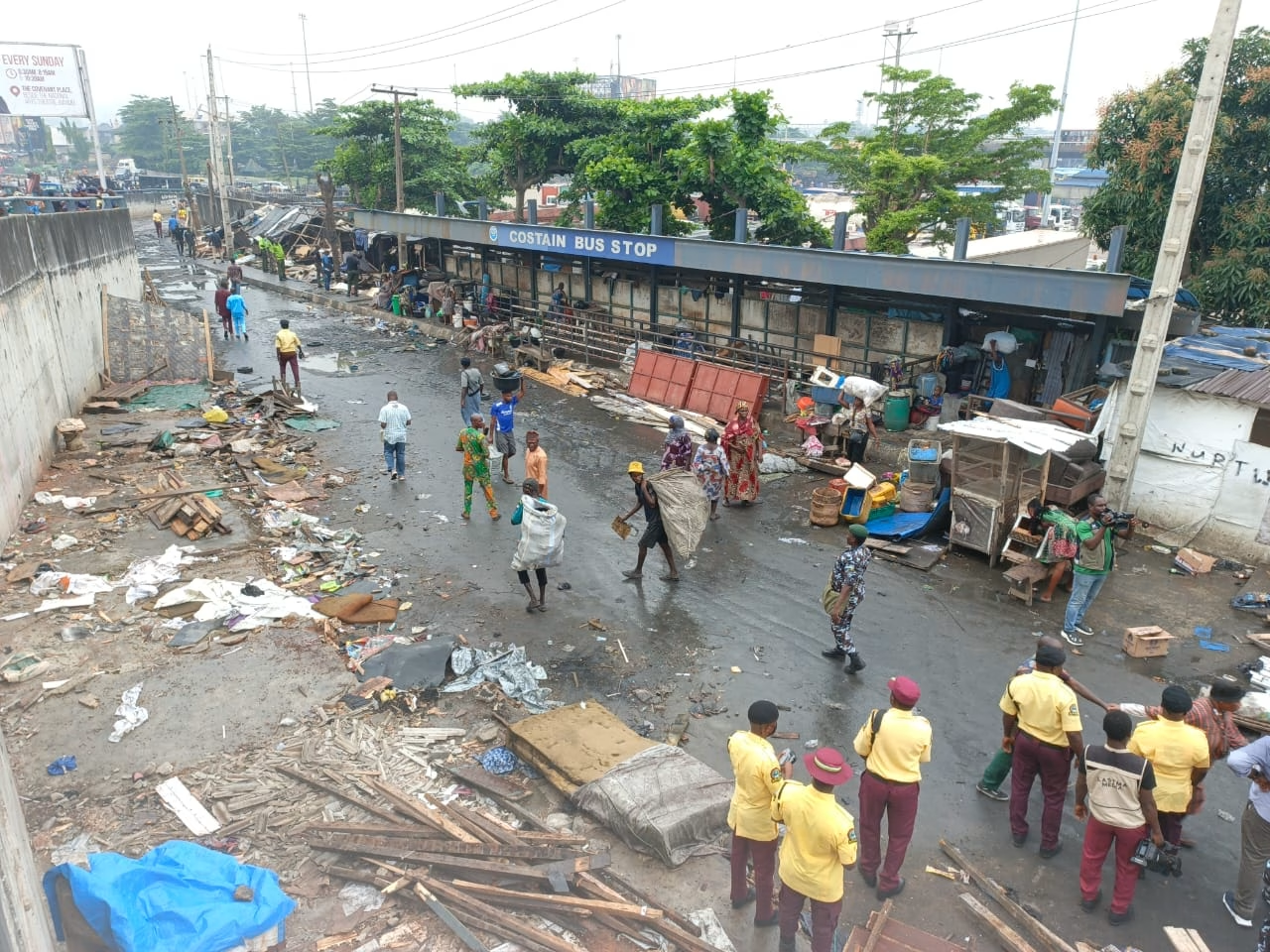
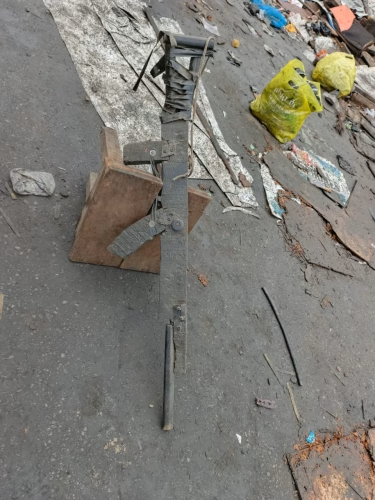
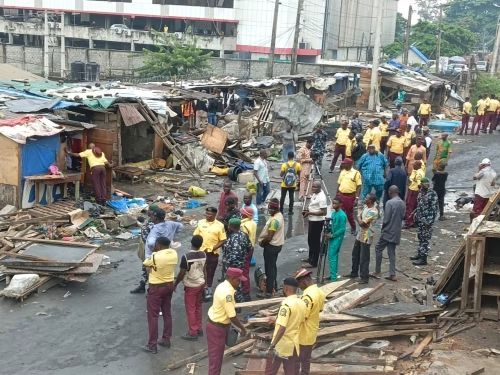
LASG DISMANTLES OVER 200 ILLEGAL SHANTIES, DISLODGES CRIMINAL HIDEOUTS AS LASTMA OPERATIVES UNCOVER DUMMY GUN BENEATH COSTAIN BRIDGE


By Ebinum Samuel


In an emphatic manifestation of its relentless commitment to urban regeneration, environmental rectitude, and the safeguarding of public order, the Lagos State Government has executed a sweeping enforcement exercise that led to the dislodgement of illegal squatters, demolition of over 200 illegal shanties, and evacuation of derelict vehicles sprawling around Apapa Road, Ijora, and Costain under bridges.


The large-scale clearance operation, meticulously coordinated through a synergy of inter-governmental agencies, was spearheaded by the Special Adviser to the Governor on Transportation, Hon. Sola Giwa. The exercise strategically targeted the reclamation and sanitization of critical public spaces that had been desecrated by unlawful habitation, environmental degradation, and nefarious criminal activities.


During the extensive operation, personnel of the Lagos State Traffic Management Authority (LASTMA) made a shocking discovery—a dummy firearm and other dangerous weapons clandestinely concealed within makeshift structures beneath the bridges. This alarming revelation underscored the exigency of the intervention and validated the State Government’s proactive stance against festering criminal hideouts in key transportation corridors.


Hon. Sola Giwa decried the appalling condition of the affected areas, characterizing the unlawful activities and shanty settlements as “a monumental affront to public decency, environmental order, and the collective security of Lagosians.” He further asserted that “no responsive and responsible government would countenance such brazen lawlessness within vital infrastructural zones that sustain the State’s socio-economic engine.”

The Special Adviser reiterated that the clearance exercise was designed to eradicate incessant traffic robberies, dismantle drug peddling enclaves, and abate chronic environmental nuisances that had plagued the axis for years. He further disclosed that the operation equally led to the removal of unauthorized garages and evacuation of long-abandoned trucks, which had been converted into criminal dens under the Ijora Bridge.


Hon. Giwa reaffirmed the unwavering determination of the Lagos State Government to sustain the tempo of urban renewal and environmental enforcement across the metropolis, warning that any attempt by displaced miscreants or illegal occupants to return to the cleared sites would be met with swift and decisive sanctions.


The multi-agency exercise featured robust participation from the Lagos State Waste Management Authority (LAWMA), Kick Against Indiscipline (KAI), Lagos Metropolitan Area Transport Authority (LAMATA), and the Nigeria Police Force, all working in concert to restore environmental order, safety, and infrastructural integrity.

Other affected areas included Apapa Road, Ijora, and Costain under bridges inward Iponri, where similar demolitions were executed to dismantle criminal hideouts and reclaim encroached public spaces.


This bold and far-reaching intervention forms an integral component of the Sanwo-Olu administration’s holistic urban renewal and environmental restoration agenda, aimed at reclaiming public infrastructure, ensuring citizen security, and preserving the aesthetic dignity and operational efficiency of Lagos State’s transportation corridors.


Hon. Giwa commended the seamless cooperation among participating agencies and enjoined residents to remain vigilant, law-abiding, and supportive of government initiatives.


He reaffirmed that the Babajide Sanwo-Olu administration remains irrevocably committed to actualizing a safer, cleaner, and more habitable Lagos one that reflects the true spirit of a 21st-century megacity.

COAS redeploys top army officers, makes new appointments (+FULL LIST)

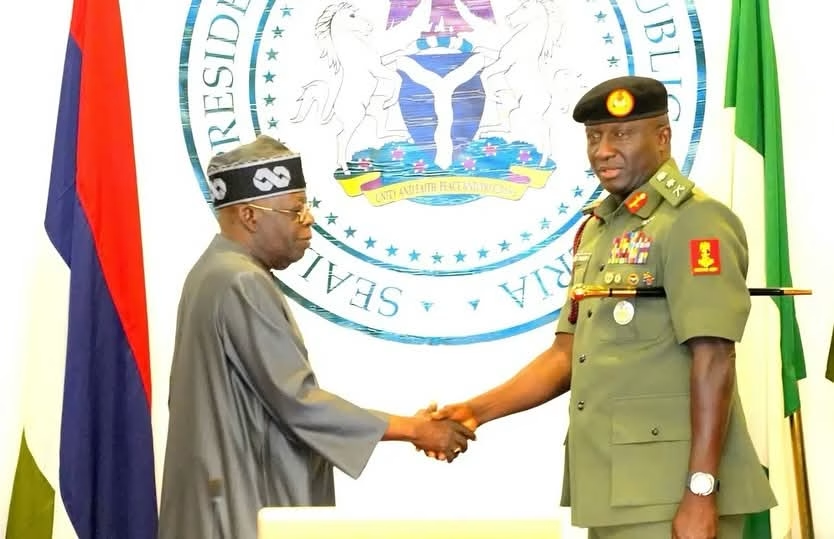
Nigeria’s Chief of Army Staff (COAS), Lieutenant General Waidi Shaibu, has approved a wide-ranging redeployment of top army officers to strategic commands, staff positions, and military training institutions across the country.

In a statement signed by Acting Director Army Public Relations, Lieutenant Colonel Appolonia Anele, on Thursday, several senior officers were assigned new responsibilities as part of efforts to enhance operational efficiency and strengthen the service’s command structure.

Among the notable postings, Major General Bamidele Alabi moves to the Army Headquarters Department of Policy and Plans as the new Chief of Policy and Plans (Army). Major General Jamal Abdulsalam, formerly Chief of Special Services and Programmes at Army Headquarters, has been transferred to the Defence Headquarters Department of Operations as Chief of Defence Operations. Major General Peter Mala departs the Office of the National Security Adviser for the Headquarters Training and Doctrine Command Nigerian Army (TRADOC), where he will serve as Commander.

Also affected in the latest shake-up is Major General Samson Jiya, who moves from the Nigerian Army Heritage and Future Centre (NAHFC) to the Defence Headquarters Department of Defence Accounts and Budget as Chief of Defence Accounts and Budget.

Other key appointments include Major General Mayirenso Saraso, redeployed from NAHFC to the Army Headquarters Department of Operations as Chief of Operations (Army); Major General Isa Abdullahi, who takes charge as Chief of Administration (Army) at the Department of Administration; and Major General Musa Etsu-Ndagi, who now heads the Department of Civil-Military Affairs as Chief of Civil-Military Affairs.

Similarly, Major General Abubakar Haruna has been moved from NAHFC to the Nigerian Army Training Centre (NATRAC), Kontagora, as Commander, while Major General Philip Ilodibia leaves the Army Headquarters Department of Policy and Plans for the Defence Space Administration, where he will serve as Chief of Defence Space Administration.

“Equally appointed are Major General Godwin Mutkut, from Multi-National Joint Task Force (MNJTF) N’Djamena to Headquarters Infantry Corps Centre as Corps Commander Infantry, Major General Umar Abubakar from the Ministry of Defence to Headquarters Nigerian Army Armour Corps as Commander Armour Corps, Major General John Adeyemo moves from Nigerian Army School of Artillery (NASA) to Headquarters Nigerian Army Corps of Artillery as Corps Commander Artillery and Major General Mohammed Abdullahi from Nigerian Army Cyberwarfare Command to Headquarters Nigerian Army Signals as Corps Commander Signals,” the statement read.

The redeployment also affected the Army’s finance, logistics, and training institutions.“Additionally, Major General Taofik Sidick has been redeployed from the NAHFC to Headquarters Nigerian Army Finance Corps as Chief of Accounts and Budget (Army), Major General Abdullahi Ibrahim from NAHFC to Headquarters Nigerian Army Ordnance Corps as Corps Commander Ordnance, Major General Adeyinka Adereti from Defence Headquarters to Headquarters Nigerian Army Electrical and Mechanical Engineers as Corps Commander, Major General Nansak Shagaya from Army Headquarters Department of Operations to Headquarters Nigerian Army Corps of Supply and Transport as Corps Commander Supply and Transport while Brigadier General Yusha’u Ahmed has been appointed Acting Corps Commander Education,” it added.

According to the statement, the COAS also approved new appointments in military schools. Major General Oluyemi Olatoye, formerly with Headquarters 82 Division/Joint Task Force South East Operation UDO KA, is now Commandant of the Nigerian Defence Academy (NDA), Kaduna. Major General Emmanuel Mustapha, from Defence Space Administration, takes over as Commandant of the Nigerian Army Signal School, while Major General Adamu Hassan moves from the Nigerian Defence Section, Riyadh, to head the Nigerian Army School of Artillery. Brigadier General John Bulus has been appointed Commandant of the Nigerian Army School of Finance and Accounts.

According to the statement, senior officers appointed as field commanders includes,  Major General Saidu Audu from Army Headquarters Department of Training to Multi-National Joint Task Force (MNJTF), N’Djamena, as Force Commander, Major General Warrah Idris from Defence Headquarters to Joint Task Force North West Operation FANSAN YAMMA as Commander and Major General Oluremi Fadairo from Army Headquarters Department of Civil Military Affairs to 82 Division Nigerian Army, Enugu as General Officer Commanding and Commander Joint Task Force South East Operation UDO KA.

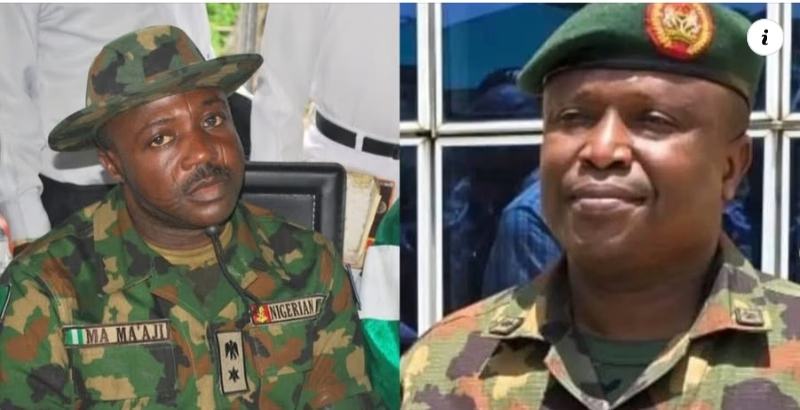
The COAS further appointed Major General Olatokumbo  Bello  as the Director Defence Media Operations at Defence Headquarters while Brigadier General Samaila Uba was redeployed from the Armed Forces Command and Staff College Jaji to Defence Headquarters as Director Defence Information.

“Lieutenant General Waidi  Shaibu charged the newly appointed senior officers to bring to bear their wealth of operational experience, administrative acumen and strategic foresight in driving a disciplined and combat-ready Army to decisively confront the  contemporary and emerging security challenges. He urged them to sustain the current operational momentum, strengthen interagency collaboration and remain unwavering in upholding the Nigerian Army’s core ethos of loyalty, selfless service, integrity and excellence,” it added.

More trouble as number of detained military officers hits 42

The number of military officers held in connection with the alleged coup attempt against President Bola Tinubu’s administration has reportedly increased to 42.

The Defence Headquarters had earlier confirmed the arrest of 16 officers over what it described as “disciplinary infractions,” without directly linking them to any coup-related activities.

However, sources revealed that the detentions were tied to an alleged plan to disrupt Nigeria’s 26-year stretch of democratic governance.

According to a report by Daily Trust on Thursday, security insiders said the arrested personnel are currently undergoing interrogation to determine the extent of their involvement and the nature of the alleged plot.

“So far, 42 officers have been picked up. They are being interrogated to establish the depth of involvement and whether there was any concrete plan beyond mere discussions,” one source said.

Another security source disclosed that the number of those arrested might rise further as investigators from the Defence Intelligence Agency (DIA) and the Military Police continue to trace communication links and possible funding sources.

Meanwhile, Presidential Adviser on Media and Public Communication, Sunday Dare, said the Presidency stands by the position of the military authorities on the matter.

Speaking on TVC, Dare reiterated that the Armed Forces remain the legitimate institution charged with safeguarding Nigeria’s unity and territorial integrity, adding that the Tinubu administration maintains full confidence in their loyalty.

“We are going to stick to the narrative of the military because they are the ones constitutionally empowered to secure this country,” Dare said. “Until the military comes with a different narrative, we are going to stay with that.”

Security analyst and retired military officer, Bashir Galma, said that the federal government may be hesitant to publicly acknowledge any coup attempt in order to prevent public panic or discourage investors.

He, however, cautioned that sustained denial could erode public trust if new evidence later comes to light.

Two officers flee as military expands arrests over alleged coup plot

Two Nigerian military officers have reportedly gone into hiding after being linked to an alleged plan to overthrow the country’s democratic government.

According to a report by The CABLE, sources disclosed that the armed forces have continued to detain additional suspects following the initial questioning of 16 officers who were apprehended in the first week of October in connection with the foiled coup attempt.

According to findings, 18 officers were slated for arrest, but two managed to escape and are now believed to have left Nigeria.

Military sources identified one of the fugitives as Major JM Ganaks, with service number N/14363, who hails from the Federal Capital Territory. Ganaks, a member of Regular Course 58 of the Nigerian Defence Academy (NDA), was reportedly stationed in Jaji, Kaduna State.

Also said to be on the run is Captain Binuga, from Taraba State. He was attached to DHQ SOF Bida, Niger State, and was part of Regular Course 64.

Information obtained from some of the detained officers has allegedly aided the authorities in apprehending more suspects, with sources estimating that over 30 officers are now in custody.

While some detainees are reportedly refusing to speak, others have been described as “very cooperative.”

Contrary to speculation, the alleged coup was not scheduled for October 1, as the arrests only took place in the first week of the month.

Although the Defence Headquarters (DHQ) has not officially confirmed the alleged coup plot, it stated that the ongoing investigation of the 16 officers is part of a “routine internal process aimed at ensuring discipline and professionalism within the ranks.”
(The CABLE)


PSC WARNS AGAINST CROWD RENTING AND PROTESTS & DEMONSTRATIONS AT ITS CORPORATE HEADQUARTERS IN JABI, INSISTS AGGRIVED PARTIES MUST FOLLOW DUE PROCESS

By Ebinum Samuel


The Police Service Commission has warned that although it will continue to ensure Police Officers are held accountable for their actions and inactions, it will not succumb to a disturbing and unfolding theatrics of crowd renting and demonstrations at the gate of its Corporate headquarters in Jabi, Abuja.

The Commission says aggrieved individuals or groups with genuine cases of Police abuse should feel free to submit petitions, which would be treated and given the required attention.

Chairman of the Commission, DIG Hashimu Argungu rtd mni, was reacting after an obviously rented crowd besieged its Corporate headquarters to demand for the setting up of a Special Investigation Panel (SIP) within 48 hours to investigate a case of criminal conspiracy, abuse of Office, robbery, terrorism… by the DPO Shendam, Plateau State and the DCO.

The Commission noted that the aggrived party has the right and freedom to submit its petitions but not to rent a crowd to magnify the allegations.

The PSC Chairman said the Commission will not be intimidated by crowd renting and will subsequently not tolerate such abuse of privilege.

DIG Argungu said the Commission’s headquarters is not an arena for demonstrations and advised that they should endeavour to follow laid down rules and regulations in the pursuit of their grievances. He advised that the aggrived party should also have reported the matter to the state Commissioner of Police before besieging its office with card carrying demonstrators.

The group had alleged that on the 22nd and 23rd of October, 2025 some hoodlums backed by “the Nigeria Police Force, I.e the DPO of Shendam, Bashiru Maisule, DCO, Jacob Ogbolu and almost 100 Policemen…..disrupted our peace, robbed us and destroyed our houses”

The Commission has however officially written and directed the DPO, DCO and other officers of Shendam Police Division mentioned in the petition to respond to the weighty allegations.

The Chairman said the Commission will get to the root of the matter and ensure that justice prevails at the end of the day.

45,853 arrested, 8.5m kilograms of drugs seized, 9,263 convicted in 30 months – Marwa

By Ebinum Samuel


Rewards 220 officers, commends personnel for raising drug war momentum under President Tinubu


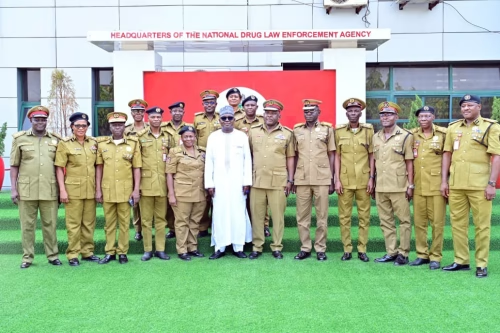
Operatives of the National Drug Law Enforcement Agency (NDLEA) have been commended for raising the momentum of the fight against substance abuse and illicit drug trafficking across the country in the past two and a half years of the administration of President Bola Ahmed Tinubu.

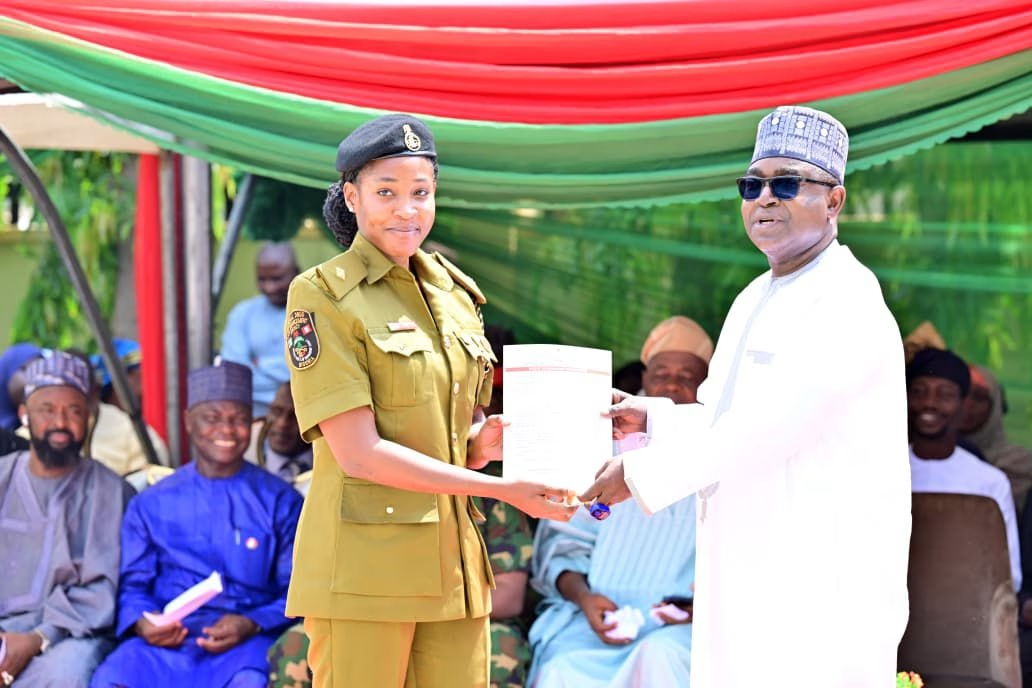
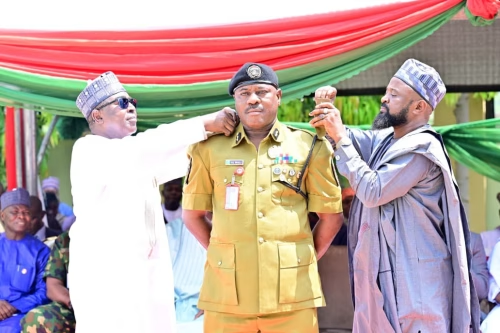
The commendation was given by the Chairman/Chief Executive Officer of NDLEA, Brig Gen Mohamed Buba Marwa (rtd) on Wednesday 29th October 2025 when he presented commendation letters and awards to 220 personnel for outstanding performance in the discharge of their duties while 15 senior officers were decorated with their new ranks.

In his remark at the event, Marwa said “Today, we specifically recognize those who have gone above and beyond. We celebrate those who, despite facing immense danger and relentless temptation, chose the path of integrity, selflessness, and uncompromising adherence to our mandate.


“Your commitment to the renewed hope agenda of the administration of President Tinubu has yielded tremendous results in the past 30 months on our two major planks of drug demand reduction and drug supply reduction, leading to 45,853 arrests; seizure of over 8.5 million kilograms of assorted illicit drugs; and conviction of 9,263 offenders; with 26,613 drug users counselled and rehabilitated in our treatment facilities across the country, while a total of 9,848 War Against Drug Abuse (WADA) sensitisation activities were conducted in schools, work places, markets, motor parks, worship centres and communities among others within the same period.”

While noting that he has upheld the tradition of hosting the commendation and awards ceremony in the last four and a half years to appreciate and encourage officers, men and women who have distinguished themselves in the line of duty, he said the challenge of the drug scourge still remains monumental and as such there’s need for more work to be done.


“Without mincing words, the challenge we face is monumental. Drug abuse, trafficking, and the associated criminal enterprises represent a direct and existential threat to the social fabric, economic stability, and national security of Nigeria. They fuel crime, corrupt our youth, and provide resources for terrorism and insurgency.

“But for every kilogram of cocaine intercepted, for every clandestine laboratory dismantled, for every major drug kingpin apprehended, a critical blow is delivered to these criminal networks. These victories, are no doubt the direct result of your dedication.”


He said the reward system he established is to maintain the momentum and keep the workforce in optimal condition—both materially and mentally, while ensuring high morale. “This is why we uphold our tradition of rewarding key virtues: hard work, loyalty, sacrifice, integrity, commitment, honesty, courage, and obedience. In addition to the traditional incentives such as promotions, training, and others (which we continue to work towards), we introduced this reward system: the CCEO Commands Awards and Commendations. This has become one of the primary ways management expresses appreciation for the efforts of the NDLEA workforce.

“If anything, our faith in the reward system has been proven right. Over the past four and a half years, we have witnessed an improvement in both the individual and collective ethos of our workforce. However, let us not forget that each gathering to celebrate and honour our finest efforts serves as a reminder to all officers of this noble agency that there is still much work to be done.

“For decades, we lagged behind, constrained by a lack of resources and limited capacity. Now that we are gaining momentum with increased capacity, we must work to roll back the influence and dismantle the structures put in place by drug cartels, using the full force of the law. In carrying out your duties, it is essential to operate within the parameters of our SOPs. Adhering to these guidelines ensures your protection”, he charged.

He expressed appreciation to local and international partners for believing in the Agency and supporting its efforts. “I cannot proceed without thanking our media partners for their collaboration and partnership in supporting our efforts. I would also like to express our gratitude to UNODC, INL, the UK Border Force, the French government, and the Government of Germany for their invaluable contributions.

“At home, we owe a great deal of thanks to the Senate Committee on Narcotic Drugs and the House Committee on Drugs and Narcotics, who, particularly over the past years, have been immensely supportive and crucial to the growth of the NDLEA as an institution. “Similarly, we extend our gratitude to the Minister of Justice and the Attorney General of the Federation as well as the Judiciary as an arm of Government. We must also express our deepest thanks to the President, His Excellency Bola Ahmed Tinubu, GCFR. We are where we are today because of the unwavering support we have received from these institutions, and we are optimistic that this support will continue, enabling us to fulfil our mandate of making Nigeria a drug-free country. Finally, we thank Nigerians for embracing the reforms we’ve implemented and for continuing to be one of our strongest partners”, he added